Category: Regional

  • The hybrid workplace: pandemic band-aid or enduring solution?

    The hybrid workplace: pandemic band-aid or enduring solution?

    By David Rockower

    When the pandemic hit, there was no time to weigh the pros and cons, listen to employee opinions or create a balanced schedule; Covid-19 necessitated physical distancing and, as a result, many businesses made the switch to remote work.

    Soon, many employers started asking questions: Do we really need all that office space? With no time spent commuting to work or traveling, how much more efficient might we become? How would working from home improve our employees’ quality of life?

    On the flip side, employers were concerned about missing that in-person community that develops organically in the hallways and lunchrooms. How else would remote work impact the company’s day-to-day operations?

    Now, with a solid two years’ experience, many companies have a clearer picture of the advantages and disadvantages of remote and hybrid work. Here’s what Happy Valley business leaders had to say on the matter.

    Local companies listened to their employees

    President of AccuWeather, Steven Smith, has been with the company for 25 years. The AccuWeather headquarters in State College employs 250 to 300 workers, but there are offices in New York, Wichita and Montreal as well, along with a growing number of remote workers.

    When asked how AccuWeather has changed in its approach to in-person versus remote work, Smith said, “[The pandemic] normalized remote work. It’s now a normal part of our job descriptions and a normal part of our recruiting.”

    “We certainly recognized that the employee’s view of where and how they do their work changed, and we needed to evolve while still preserving the core elements of our culture.”

    AccuWeather, he said, started to look at things from a job classification standpoint. Teams examined each role in the company, asking, does this need to be an on-site job? Could this be a remote job, or might it be a hybrid position?

    Some positions are clear-cut. For example, Smith said, “We have a security team at our State College facility. We are doing 24-hour broadcasting, and there are rules that the FCC puts on us, so we have to have a security team. That’s not a remote job; that’s not even a hybrid job. That’s a job that has to be on [premises] in the building.”

    While some positions operate well as either in-person or fully remote, though, the hybrid model is a bit trickier. Smith explained, “The word became a battleground conversation because there were a lot of opinions of what hybrid was and would become. Ultimately, we have settled on hybrid as three days in an office.”

    “[The pandemic] normalized remote work. It’s now a normal part of our job descriptions and a normal part of our recruiting.”

    Smith allows the details of hybrid work as a function of the managers. Most employees have settled on spending Tuesday, Wednesday and Thursday in-office, while working from home on Mondays and Fridays.

    “One of the things we talked about was, if you’re going to be hybrid, make it purposeful. Don’t just come to the office and do zoom meetings,” Smith said, noting he encourages his managers to hold group meetings on those in-person days, so that the team can spend time in-person, together.

    AccuWeather’s remote team makes up nearly 35% of its total workforce. Credit: AccuWeather

    Restek, a leading developer and manufacturer of chromatography consumables, already had a pre-pandemic U.S. remote workforce that made up 6.7% of its company. Today, that number is 36.5%, including all fully-remote and hybrid employees. Chris Marshall, vice president of human resources at Restek, explained, “We certainly recognized that the employee’s view of where and how they do their work changed, and we needed to evolve while still preserving the core elements of our culture.”

    “The word became a battleground conversation because there were a lot of opinions of what hybrid was and would become. Ultimately, we have settled on hybrid as three days in an office.”

    Marshall heard from employees that remote work allowed them a better work-life balance: “It was easier for them to get their kids on the bus in the morning, attend evening activities and get dinner on the table. Certainly, there are studies showing improved mental health for workers who don’t have to go into the office every day.”

    Additionally, Marshall noted that employees save time and money not having to commute to and from work.

    Increasing the talent pool and diversifying the workforce

    Both Restek and AccuWeather recognize the benefit of remote work in their recruiting efforts.

    Smith explained, “The number one thing [remote work] changed for us was recruiting. It’s really allowed us to say, ‘Hey, you don’t have to move to State College or New York. You can live in Oregon and join our team.’ It opened recruiting up, which then in turn increased our diversity—tremendously.”

    “Meetings became transactional. You schedule a Zoom meeting, but there was nothing serendipitous about what you were doing. We had topic A, we solve topic A and everybody hits the goodbye button, and that became the end of it.”

    Attracting diverse workers to State College has always been a challenge, and both Smith and Marshall emphasized how remote work has provided a new pathway to diverse talent. That’s something they don’t want to lose.

    On the flip side, one of the big disadvantages to remote work has been that meetings became scripted.

    “Meetings became transactional. You schedule a Zoom meeting, but there was nothing serendipitous about what you were doing. We had topic A, we solve topic A and everybody hits the goodbye button, and that became the end of it,” said Smith.

    There was no after-meeting sharing of ideas, no checking in on one another. In essence, opportunities for building community and creativity idea-generation were lost. Smith said, “We are still working to answer the question: How do you create those opportunities to just allow people lean-back time and be the collective mind to drive the organization?”

    Similarly, Marshall explained that, with an increase of remote employees, it can be difficult to maintain a healthy work culture. “How do you get new hires integrated into the culture? How do you introduce them to the company? How do you introduce them to their new team?” she posed. These are questions companies are continuing to work through.

    Restek had a pre-pandemic U.S. remote workforce of 6.7%. Today that number is 36.5%. Credit: Restek.

    For employees, the advantages outweigh the disadvantages

    Lori Dundon has worked in the marketing department at Restek for the past 15 years. She appreciates the flexibility that remote and hybrid work allows. “Working remotely allows me to have Microsoft Teams meetings with my colleagues in Europe and Asia outside of work hours without any undue hassle. It allows me to eat healthier, because I was never very good at packing a lunch,” said Dundon.

    However, Dundon admits that there are still disadvantages. While one would think that being away from Restek’s office would make it easier to separate work and home life, Dundon explained, “The biggest disadvantage I can think of is that my work is always in the other room. It’s harder to say, ‘I’m done for the day’ and walk away. I tend to take my laptop to the living room and do a little more work after dinner.”

    “Working remotely allows me to have Microsoft Teams meetings with my colleagues in Europe and Asia outside of work hours without any undue hassle. It allows me to eat healthier, because I was never very good at packing a lunch.”

    Overall, though, Dundon feels fortunate to work for a company that allows its workers so much flexibility, “I am very lucky. Our department has members in six countries and I believe most of us are hybrid or full-time remote.”

    The new normal?

    It’s clear that the pandemic shifted our view of the traditional workday and, according to Marshall, we may never go back. She said, “COVID dropped us in the deep end. It provided us this unprecedented opportunity to think differently about how and where we do our work. I don’t think we are going to view work as 9 to 5, you’ve got to be in the office every day all the time anymore. I just don’t see it.”

  • The Make Space of Centre County promotes self-sufficiency and creativity

    The Make Space of Centre County promotes self-sufficiency and creativity

    By Stephanie Kalina-Metzger

    A Make Space member uses a table saw for a project. Photo: The Make Space of Centre County.

    As technology advances, creative individuals can, too — that is, if they’re provided with the resources to take their ideas from concept to reality. That’s the thought behind The Make Space of Centre County.

    The organization began when founding member John Stitzinger picked up a 3-D printer at a convention out of curiosity. Eventually, that printer was used to print pieces for another printer and the plans were uploaded to a Wiki page so that others could collaborate to make the second incarnation of the original printer even more efficient. Now, other projects that have been created in The Make Space over the years include key chains, toys, pieces for drones, weathervanes and even a Tesla coil.

    “Operating in Happy Valley gives us many valuable opportunities and puts us into contact with the most diverse and ambitious individuals in Pennsylvania who are just starting their research, studies and careers.”

    Approximately 11 years have passed since its inception and The Make Space continues to evolve, attracting engineers, designers and tinkerers of various abilities and backgrounds, who can use the equipment for a small monthly charge.

    “It’s also a great option for people who live in apartments and lack the space to work on larger projects,” said Jason Gallaway, who serves on the nonprofit’s board.

    “A university the size of Penn State creates an environment that produces many unique, fresh and creative ideas and projects from our members, who themselves are a mixture of students, staff and residents of the community around Happy Valley. Giving people an outlet for their innovation and personal expression through making and creating is very rewarding.”

    The nuts and bolts

    The Make Space, which describes itself as a community workshop, is comprised of two large rooms spanning 1,000 square feet where creatives can get together and bring their ideas to life. The front room contains electronics, with computers, 3D printers, laser cutters, engravers and a soldering section. Room number two is the construction zone containing the woodshop, where visitors can work with table saws, a lathe, a miter saw and other woodworking tools.

    According to Gallaway, the overarching goal is to promote self-sufficiency. “We promote the idea that people aren’t required to just buy what the industry puts in front of them,” he said, citing instances where people can print what they need for repairing, or improving items.

    A community member gets her gears tuned and ready for a season of bike riding. Photo: The Make Space of Centre County.

    Creators weigh in

    Karl Raynar has been using The Make Space since 2019. “They hosted an open house and were laser-cutting Christmas ornaments out of cardboard. My wife was very taken by it and then I got interested in it too,” said Raynar, who makes use of the laser cutter on site to make weathervanes. “So far I’ve created vanes in the likeness of my wife on a horse when she was younger, an angel and a family symbol, which is a fish and an anchor,” he said.

    “State College is a really nice town, which has a lot going on and is always pushing the boundaries in terms of innovation, trying to be on the cutting edge.”

    Vidur Ramlall is also a frequent visitor, having used the shop since 2012. He makes decorative boxes, keychains for events on Penn State’s campus, computer parts, robot parts and more.

    “It gives me the space to do all kinds of things,” he said, also mentioning the Make Space’s CNC machine, which processes a piece of material to meet specifications by following coded programmed instructions. “I used that to make a Tesla coil,” he said.

    Ramlall’s made his home in State College because of places like The Make Space. “State College is a really nice town, which has a lot going on and is always pushing the boundaries in terms of innovation, trying to be on the cutting edge,” he said.

    Gallaway agreed that The Make Space is an excellent place for creative minds to gather. “Operating in Happy Valley gives us many valuable opportunities and puts us into contact with the most diverse and ambitious individuals in Pennsylvania who are just starting their research, studies and careers.”

    Gallaway added that being in a college town community naturally fosters a creative environment.

    “We promote the idea that people aren’t required to just buy what the industry puts in front of them.”

    A university the size of Penn State creates an environment that produces many unique, fresh and creative ideas and projects from our members, who themselves are a mixture of students, staff and residents of the community around Happy Valley. Giving people an outlet for their innovation and personal expression through making and creating is very rewarding,” he said.

  • Local leaders on the current state and future of manufacturing in Happy Valley

    Local leaders on the current state and future of manufacturing in Happy Valley

    By Timothy Kelly

    An article published by Bloomberg in July focused on the accelerating reshoring trend in manufacturing and noted that companies aren’t just talking about reshoring — they’re taking action. Some companies are moving their supply chains, including primary production facilities, out of China and relocating to the U.S. According to the article, the construction of new factories in the United States has increased 116% since last year. Manufacturers of semiconductors, steel and aluminum are relocating to the United States as well.

    Leaders from five local companies weighed in with their views. We also asked if they have experienced the effects of the reshoring trend and how they’re faring in the current economic climate. Here’s what we learned.

    What are your thoughts on the Bloomberg article?

    Todd Erdley, founder, chairman and president of Videon, noted, “As a country we can’t [currently] do what we need to do because all of our chip manufacturing is in Taiwan and China.” Overseas wage increases, multiplied shipping costs, geopolitical strife and labor shortages all contribute to the breakdown in the international supply chains, so it makes economic sense to eliminate those points of breakage where possible.

    Maureen Mulvihill, PhD, president and CEO of Actuated Medical, Inc. added, “… With the uncertainty and backorder timelines coupled with the global surge in demand, there is an economic reason to diversify and bolster chips manufacturing in the United States.”

    Gary Barone, director of engineering and business development at SilcoTek Corporation, said, “Yes, we are seeing similar onshoring, or ‘re-shoring,’ trends amongst our customer and supplier base.”  Barone also said that, in his experience, large original equipment manufacturers (OEMs) “are looking for alternatives to streamline and consolidate their supply chains.”

    Workers in the Actuated Medical lab. Photo provided.

    What’s the state of manufacturing in Happy Valley?

    Despite the challenges of current economic conditions and the Covid-19 pandemic, many Happy Valley manufacturers have remained healthy. There seem to be several reasons why they have fared well.

    First, local companies responded quickly and adapted to the changes in the supply chain in 2020. They were prepared to think creatively and act decisively when facing the new challenges.

    Fred Marroni, president and CEO of Indigo Biosciences, Inc., said that his firm was forced to look for products from other sources and focus on domestic suppliers. He said, “While supply chain issues created a challenge, we managed to continue to produce product to meet customer demand.”

    Similarly, Erdley said about Videon, “ I’m very … proud to say we have not missed a single shipment over the last three years.”

    These businesses have also maintained a commitment to the fundamentals of healthy operations throughout the last few years. Erdley said, “… here in central Pennsylvania, companies… are more focused on operating with a high level of commitment to the fundamentals… We have operational commitments here in central Pennsylvania.”

    At ConidioTec, CEO Don McCandless said that maintaining cash flow has been a key piece of the organization’s success. A solid cash flow enabled ConidioTec to respond to changing demands like new, larger minimum order quantities for components and supplies.

    Erdley, Marroni and McCandless also all indicated that carrying inventory, in some instances well above their organizations’ immediate needs, was important to their success over the last few years.

    Erdley said, “The more that you have that vertical integration, and the more that you have great processes and great forecasting, the better you’re going to be.” McCandless added that planning, foresight and paying attention to global events helped ConidioTec weather recent storms.

    Happy Valley companies’ deep tech origins

    Perhaps the most fundamental factor helping Happy Valley manufacturers thrive has to do with their deep tech origins. Deep tech is defined as high-tech products or services that solve persistent or vexing technical problems by the application of novel engineering solutions and/or scientific discoveries. Many local companies started with deep tech concepts from the results of Penn State research.

    Ultimately, Happy Valley’s deep tech employers may keep the local economy elevated above the national averages.

    Happy Valley has a long history of successful deep tech startups. For example, State of the Art, Inc. founded in 1969, has been providing its customers with high-tech resistor products since the 1970s, almost 40 years before the phrase “deep tech” was coined in 2014.

    Chip shortage may continue to be a manufacturing challenge

    Mulvihill noted that “even with the significant government support, it will take many years for these chip manufacturers to begin producing products that industry needs today. We will still have supply chain issues while companies scale up production in the United States.”

    Marroni echoed Mulvihill’s conclusion. “The near-term challenge will be that the facilities will take years to construct. Site identification, governmental permits, infrastructure and construction will take many years,” he said.

    What does the future hold?

    Erdley said the flow of money into the economy from the pandemic assistance programs and the rising stock market has artificially inflated some company positions. The pendulum is likely to swing back, leading to a correction in the economy, he said, noting “… from a global economic perspective… there was bound to be a bit of a downturn.”

    He added that the sky isn’t falling, we’re just seeing a “right-sizing of… companies that needed a bit of adjustment.” The recent downward correction in the chip market seems to reinforce his assessment.

    Consequences may include layoffs, wage growth being “tapped down” and more conservative business spending. Erdley also expects that “the opportunity to rapidly switch jobs will be muted to a degree.” It remains to be seen if the worker shortage will offset the potential layoffs and wage compression Erdley predicted.

    Marroni noted that “the access to raw materials may turn out to be the biggest challenge in redeveloping manufacturing capabilities domestically.”

    Erdley warned that business based on a landed cost, that is, the sum of expenses associated with shipping a product, of “devices, functions, whatever, from overseas … are going to be … in a tenuous position.” Shoring up the supply chain back to the United States and becoming vertically integrated would put such a business in a better position.

    Russia’s war with Ukraine, China’s recent sword rattling and its real estate crisis add to the uncertainty of the economic landscape.

    Ultimately, Happy Valley’s deep tech employers may keep the local economy elevated above the national averages.

    How is your company adapting to supply chain disruptions? Do you have any lessons you can share? Let us know!

  • Happy Valley ready for a health care renaissance

    Happy Valley ready for a health care renaissance

    By Holly Swanson

    Credit: Provided by Geisinger

    When Wendy Oakes made the decision to return to State College from San Francisco, she knew what to expect. Her college years at Penn State and frequent return trips to Happy Valley gave her a taste of the year-round festivals, sporting events, music and art productions and plenty of restaurant options.

    With new state-of-the-art facilities and specialty health providers moving into the Happy Valley, access to advanced, highly skilled medical care will be just minutes away from residents’ homes.

    But as she began her second career, now as the associate director in Penn State’s Center of Excellence in Industrial Biotechnology, she had only one slight hesitation when talking up her move to colleagues — the lack of high-quality medical subspecialties in the area.

    “For decades, I had access to some of the best medical facilities in the country, which are commonly located in major metropolitan areas,” Oakes said. “I was concerned mostly for my mother, who was moving to State College with me. She was, at the time, an 82-year-old cancer survivor in need of specific treatment options for the health challenges we encounter as we age. I wanted to feel confident that State College had those options for Mom, without needing to take her to Philadelphia or PIttsburgh for treatment.”

    While the Happy Valley’s medical professionals have provided quality and compassionate  health care to its residents for decades, the growing, as well as aging, population is in need of access to the latest, cutting-edge technologies and novel treatments that peers receive in larger cities. In short, residents need more readily available health care options closer to home.

    Fortunately for State College and the surrounding communities, some of Pennsylvania’s largest and most advanced medical providers are seeing this challenge as an opportunity. To say the region is experiencing a health care boom would be an understatement. With new state-of-the-art facilities and specialty health providers moving into the Happy Valley, access to advanced, highly skilled medical care will be just minutes away from residents’ homes.

    Penn Highlands plans big expansion

    While Penn Highlands’ presence in Centre County has been recognizable for several years by way of its laboratory and specialty outpatient services, the health care system with eight hospitals located to the west of Happy Valley has started construction on a new, freestanding hospital. The facility will focus primarily on outpatient treatment, such as minimally invasive surgeries and endoscopies, but will also offer screening, imaging and diagnosis services.

    Also located within the 82,000-square-foot hospital and 32,000-square-foot medical offices will be 18 inpatient beds and a trauma and emergency center, as well as medical providers including family medicine, lung and heart specialties, OB/GYN care and imaging services. A branch of the Penn Highlands Hahne Cancer Center will also be housed in the new building, providing access to the program’s oncology and immunotherapy treatment services.

    The $70 million project promises to be patient-focused, while providing some of the most technologically advanced care in the area.

    Penn State Health continues its growth

    After establishing itself as a health care leader in the region, Penn State Health continues to offer research-driven and patient-centered care for all residents. As part of the world-renowned Penn State Health Milton S. Hershey Medical Center and Penn State College of Medicine, the providers at the eight State College locations are teaching and training the next generation of doctors, nurses and health professionals.

    In addition to primary care and a wide variety of specialty care options for adults, Penn State Health offers several pediatric specialties, including dermatology, orthopedics, cardiology and surgery follow-up and post-procedure care, all within the county.

    As services continue to grow in the region, Penn State Health is actively recruiting doctors and nurses, as well as support staff, for its care teams. The newest offering comes from the vascular team at Penn State Health. The team will begin performing TransCarotid Artery Revascularization(TCAR) procedures for carotid artery blockages under the leadership of Gene Simoni, M.D. In the past, patients would need to travel out of town for this procedure, but now can remain close to home while still receiving world-class health care.

    Kirk Thomas, chief administrative officer of the Geisinger Western Region. Credit: Provided by Geisinger

    Geisinger expands care throughout Happy Valley

    While Geisinger has been a long-standing provider of health care to Happy Valley, recent expansions are allowing it to provide services to new populations, with continued growth expected for the next few years. The opening of Geisinger 65 Forward serves patients 65 and older who have Geisinger Gold Medicare. The center provides services such as on-site laboratory testing, imaging and mental health treatment, as well as social and educational activities like yoga and card games. Geisinger 65 Forward also provides senior-focused primary care for patients, offering longer appointment times to help manage and meet the demands of chronic health conditions.

    “Geisinger 65 Forward State College has been very positively received since we opened our doors to the local community about one year ago,” said Kirk Thomas, chief administrative officer, Geisinger Western Region. “Dr. Scott Sulman and Dr. Susan Holencik have been working to provide the best care to our patients and community.”

    “Everything is under one roof in a calm, relaxing environment that feels more like a spa than a clinic,” Thomas said. “We see patients coming in to see their doctor and staying to interact with peers, while enjoying the different offerings of 65 Forward.”

    Meanwhile, Geisinger’s Scenery Park primary care offices are expanding to a new 15,000 square-foot facility. The new building will be located right across the street from the current facility and is now under construction.

    “Meeting the needs of the Centre County community remains a priority for Geisinger,” Thomas said. “We continue to plan, recruit and grow our programs and services both in primary care and specialty areas. We’re making better health easier for our friends, family and neighbors right here in Centre County.”

    While the Happy Valley’s medical professionals have provided quality and compassionate  health care to its residents for decades, the growing, as well as aging, population is in need of access to the latest, cutting-edge technologies and novel treatments that peers receive in larger cities.

    Mount Nittany Health grows into Toftrees Space

    After several construction projects in recent years that expanded the Mount Nittany Medical Center building, Mount Nittany Health will soon begin construction in the planned Toftrees West area. This outpatient medical facility will encompass more than 125,000 square feet of space spread across four floors. The site was chosen specifically for the land’s potential for future growth and is part of a long-term vision to include housing developments, retail space and office buildings.

    In addition to dedicated physician space, the new Mount Nittany Health building will include rehab facilities, diagnostic services, labs and procedure rooms.

  • Educating Happy Valley’s next generation of changemakers

    Educating Happy Valley’s next generation of changemakers

    By David Rockower

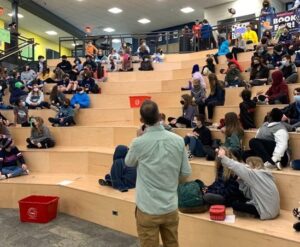
    Delta middle teacher, Paul McCormick, leads a whole-school community-building activity (Credit: David Rockower)


    It’s tough to have a conversation about State College without mentioning academics. Being near Penn State — one of the 20 largest universities in the country — education is everywhere. However, living under the blue and white umbrella of Penn State, The State College Area School District (SCASD) is sometimes overlooked. But SCASD is a force in its own right.

    According to Niche.com, SCASD ranks 14th out of 494 school districts in Pennsylvania. One of the many strengths of the high school is its abundance of course offerings. Beyond traditional core classes, SCASD offers an impressive catalog of electives. Through its career and technical center, students can take classes like business finance, supply chain management, sports marketing, computer science, early childhood education, culinary arts and automotive technology. International Baccalaureate and Advanced Placement courses are offered as well. SCASD does its best to make sure there are educational opportunities for every type of learner.


    Ownership of education

    Another option for middle and high school students is The Delta Program.

    Jon Downs, director of educational alternatives and principal at Delta, explained, “It’s a small, democratic school within State College School District. We have a middle school cohort of grades six to eight and our high school cohort of grades nine to 12.”

    “Really it’s a school that is trying to turn the ownership over to the students and to their parents.”

    Students and parents help make decisions about how the school operates. For example, each time a new teacher is hired, a committee of teachers, parents and students work with Downs to select the best candidate. Downs continued, “Really it’s a school that is trying to turn the ownership over to the students and to their parents. We want this to be the students’ school, not the teachers’ or administrators’ school. We want it to be a very flat hierarchy, and a really a safe space for kids to take ownership of their education.”

    A middle-school student facilitates a weekly all-school meeting (Credit: Jon Downs)


    What does this look like in practice?

    Students and teachers are on a first-name basis. Classes are mixed-grade-level, so in middle school, grades 6, 7 and 8 are in classes together. At the high school, grades 9, 10, 11 and 12 are in classes together. Each program has an advisory council — comprised of students, parents and teachers — that makes decisions about the school. Students hold the majority vote.

    “This year, with guidance from teachers and parents, students changed the cell phone policy. Later, the teachers proposed a new schedule and the kids weren’t necessarily supporting it. They said, ‘Let’s try it for a week,’ so we shifted our schedule matrix for a week. We have a lot of flexibility. I think that’s what sets us apart from traditional schools,” said Downs.

    Course offerings are non-traditional. For example, instead of seventh-grade social studies, students can sign up for classes like Digital Citizenship, Law & Order and American History Through Music. Rising 10th grader, Maya Dombroskie, explained just how much she values choice: “I feel like it gives you much more ownership over your education, and when you have ownership over your life and what you’re doing, you’re much more likely to take responsibility and care about the choices you make.”

    Student voice is not limited to choosing from a catalog of courses; it bleeds into everyday classroom discussions and decisions about school policy. Delta’s commitment to student voice breeds confidence. Dombroskie said,

    “Delta has given me the skills and the practice to always be ready to constructively, but firmly, speak my mind. So, I’m ready to voice my opinion. To make it heard and engage with others about their opinions and really turn it into a constructive forum where everyone is learning and decisions can be made.”


    A school that feels like a second home

    Molly Countermine’s three children have all attended Delta. “Delta was always on my radar because I knew that it was sort of this little gem of a community school nestled in this really big renowned, academically driven School District,” said Countermine. She knew that she wanted a school that felt like a second home for her kids. When Countermine first took a tour of the school and met with the director and teachers, she recalled a crucial comment: “I remember Jon (Downs) saying ‘We’re a community first and a school second,’ and that was probably one of the most perfect things he could say to my family.”

    Countermine also shared how motivating the classes are for her kids: “They’ve got classes that teachers designed because they are passionate about a subject — so a class on what it means to be a good digital citizen, or what it means to write and read sports stories. Your kids are going to find classes they love because the teacher loves teaching them.”

    Anytime there is an alternative offering, something different from the norm, rumors will swirl, as people try to conjure a clear picture of what kind of student attends a given school. But Delta isn’t for a specific kind of student. Any independent learner with a desire to be part of a smaller learning community can find success at Delta.

    Rising Sophmore Mathes Miller-Priddy summed it up perfectly. “Delta is a school for anyone with an interest in democracy and building community. It’s been an incredible resource and influence on my life and I believe that the skills I’ve gained from being an active member of its community are ones that anyone could use in academia and beyond.”


    Citation: Senior, Alum, & Parent. (2019, September 7). Explore State College Area School District. Niche. Retrieved July 12, 2022, from https://www.niche.com/k12/d/state-college-area-school-district-pa/ 

  • Stigma, safety and a green future?

    Stigma, safety and a green future?

    By Caryn Anderson

    The exterior of Curaleaf’s Happy Valley location. Photo: Curaleaf

    Medical marijuana is still relatively new in Pennsylvania. Governor Wolf signed it into law in April 2016 and the region’s first dispensary, Nature’s Medicines (now Ayr Wellness) opened in 2018. In February 2022, Curaleaf offered a second option and the latest dispensary, Verilife, opened its doors in April 2022.

    We were able to connect with David Chiovetti, president of Verilife, and Beth Ferracone, Curaleaf’s director of retail marketing. Here’s what we learned about their industries and what the future for medical marijuana looks like in Happy Valley.

    Overcoming negative opinions

    When asked about the challenges of opening a medical marijuana dispensary, both executives said marijuana’s stigma was one of their biggest obstacles.

    “As someone who has been working in the cannabis industry for their entire professional life, one of the challenges is always going to be overcoming the stigma attached to the plant,” said Ferracone. “Curaleaf seeks to make medical marijuana something everyone can understand, and you will feel that when you walk into each of our stores.”

    Because the company understands that medical marijuana is a highly personal choice, Curaleaf offers a variety of forms, functions and products for all patients’ needs.

    “As the number of medical patients continues to grow, we plan to grow alongside providing patients with quality products and services to make confident and informed decisions about their medical marijuana journey,” Ferracone said.

    A rendering of the second phase of the Happy Valley Verilife buildout. Photo: Verilife

    Chiovetti echoed the sentiment. “There’s still a little bit of a stigma. Sometimes, local residents and other businesses may be concerned with what type of element we would bring to that area,” he said. “There is still that stigma toward medical marijuana in general. But honestly, once we identify a location, we start working with the community immediately and the support we’ve gotten from the Happy Valley community has actually been tremendous. They’ve really embraced us, which is really important for us. We’re a fairly large, multi-state operator, but we want to look and feel like the local, neighborhood medical dispensary.”

    While getting established, it’s important to work with local police and to make sure the location is compliant with regulations and guidelines. Chiovetti noted that when Verilife opens a dispensary, the area actually becomes safer.

    He said, “Our commitment to regulations and safety means that there’s no loitering and no consumption. The area is kept clean and the opposite of what people expect is what happens. Because of that, the community has really rallied around us.”

    When asked about the benefits of being located in Happy Valley specifically, Chiovetti said, “It’s one of my favorite locations in the entire portfolio, to be honest with you. As we all know, State College is well known as the home of Penn State University. Not just that university being an anchor, but also this thriving community of more than 42,000 people.”

    The business of medical marijuana

    “The Pennsylvania medical marijuana market continues to show excellent growth,” said Ferracone. “As of February 2022, more than 729,000 patients and caregivers are registered for the Pennsylvania medical marijuana program and eligible to obtain medical marijuana in the state. We’re also excited about the recent passing of adult-use in our neighboring state [of] New Jersey, and believe it is a significant milestone that will increase access to cannabis, de-stigmatize the plant and generate much needed tax revenue, jobs and business opportunities in the Northeast.”

    There are currently 23 qualifying medical conditions that make patients candidates for medical marijuana cards.

    The State College Verilife team outside of the Happy Valley dispensary. Photo: Verilife

    Chiovetti used his own mother’s experience as an example of how effective medical marijuana could be. Although never an advocate for cannabis, after struggling for years with insomnia and trying other remedies that left her waking feeling groggy, she decided to try medical marijuana. With the right dosage, she says she’s had the best sleep she’s ever had and has since become an ambassador for just how safe, lab-tested and easy-to-understand the dosage of medical marijuana is.

    “When you actually change somebody’s life and they’re able to get better sleep or be more mobile or have less pain, it’s just great,” Chiovetti said.

    The future looks green

    Both companies are optimistic about the future of medical marijuana. Curaleaf looks to its 11-year history of serving medical patients and seeks to continue providing exceptional service in Happy Valley and beyond.

    “Curaleaf is a high-growth cannabis company known for quality, expertise and reliability,” noted Ferracone. “The company and its brands, Curaleaf, Select and Grassrooms, seek to continue providing industry-leading service, product selection and patient accessibility in the communities we operate in. We strive to create more meaningful and inclusive experiences for our team members, patients and communities.”

    Verilife also sees a bright future ahead. An expanded location is slated to open in late 2022, offering increased education and resources for an experience that can be tailored to individual needs.

    “Sometimes, local residents and other businesses may be concerned with what type of element we would bring to that area. There is still that stigma toward medical marijuana in general. But honestly, once we identify a location, we start working with the community immediately and the support we’ve gotten from the Happy Valley community has actually been tremendous. They’ve really embraced us, which is really important for us. We’re a fairly large, multi-state operator, but we want to look and feel like the local, neighborhood medical dispensary.” 

    Chiovetti noted he recommends people remain open to possibilities. “Once patients actually come into our dispensaries, that’s when they really have their eyes open to how the space is changing and how it really is the future.”

    “I think the future is bright for medical marijuana, as well as down the road, recreational use. We’ve seen with more and more research and scientific studies that we all learned about how much cannabis really helped people,” he concluded.

    What do you think about how Happy Valley has embraced medical marijuana? Comment below to share your thoughts.