Category: Innovation

  • “Making the impossible possible”

    “Making the impossible possible”

    By: Sarah Taylor

    Some of SilcoTek’s coated products | Image Credit: SilcoTek’s “where can you buy SilcoTek coated products?” blog

    Phones, laptops, smart refrigerators and manufacturing line machines. What do they all have in common? They all need microchips. 

    Everyone uses some type of these electronic devices, but not many people know that contaminants in metals such as stainless steel can cause failures in the manufacturing of microchips. Besides it being expensive to fix the corrosion failures, these contaminants can also make it difficult for researchers to accurately analyze human and chemical samples, leading to a hindrance in scientific discovery.

    SilcoTek Corporation, though, has discovered the solution: game-changing coatings that improve manufacturing performance and research capabilities. 

    “We originally discovered and solved this problem in analytical chemistry on chromatography columns as part of Restek Corporation,” SilcoTek President and Head Coach Gary Barone explained. This discovery led to the formation of SilcoTek in 2009, focusing solely on providing coating solutions. “We focus on high technology-driven markets with companies who are solving some of science and engineering’s most important challenges.”

    “We focus on high technology-driven markets with companies who are solving some of science and engineering’s most important challenges.”

    According to Barone, SilcoTek “envisions a world where new scientific discoveries are possible, processes are more efficient and advanced, and society as a whole benefits from the new capabilities that our coatings enable.”

    SilcoTek’s customers range from manufacturers of medical diagnostic equipment to smartphone companies, and impact ordinary people’s lives. Numerous companies within four major industries — semiconductor manufacturing, analytical chemistry, life sciences and energy — have adopted SilcoTek’s coatings to improve their performance and efficiency, benefiting those who use and depend on the produced technologies.

    “Our customers often tell us that ‘we make the impossible possible’ for them and their customers,” said Barone.

    Like many businesses, SilcoTek began and stayed in Happy Valley. Why? Barone gladly explains: “Happy Valley contributes unique technology, talent and intellectual capital to many of the industries SilcoTek serves as a coatings provider.” 

    “Happy Valley contributes unique technology, talent and intellectual capital to many of the industries SilcoTek serves as a coatings provider.” 

    He added that, “coupled with resources available through the university, our small community plays a large role in advancing global innovation and business…and being headquartered here [in Happy Valley] opens up doors for collaboration we likely wouldn’t have elsewhere.”

    Learn more at https://www.silcotek.com/ and, if you enjoyed this story, sign up for HappyValley Industry’s free weekly newsletters, covering all things industry, innovation and entrepreneurship in this incredible local region.

    Sarah Taylor is a communications professional. Sarah can be reached at sarah.st.taylor@gmail.com.

  • Different disciplines are a catalyst for innovation at X-Hab 3D

    Different disciplines are a catalyst for innovation at X-Hab 3D

    by Holly Riddle 

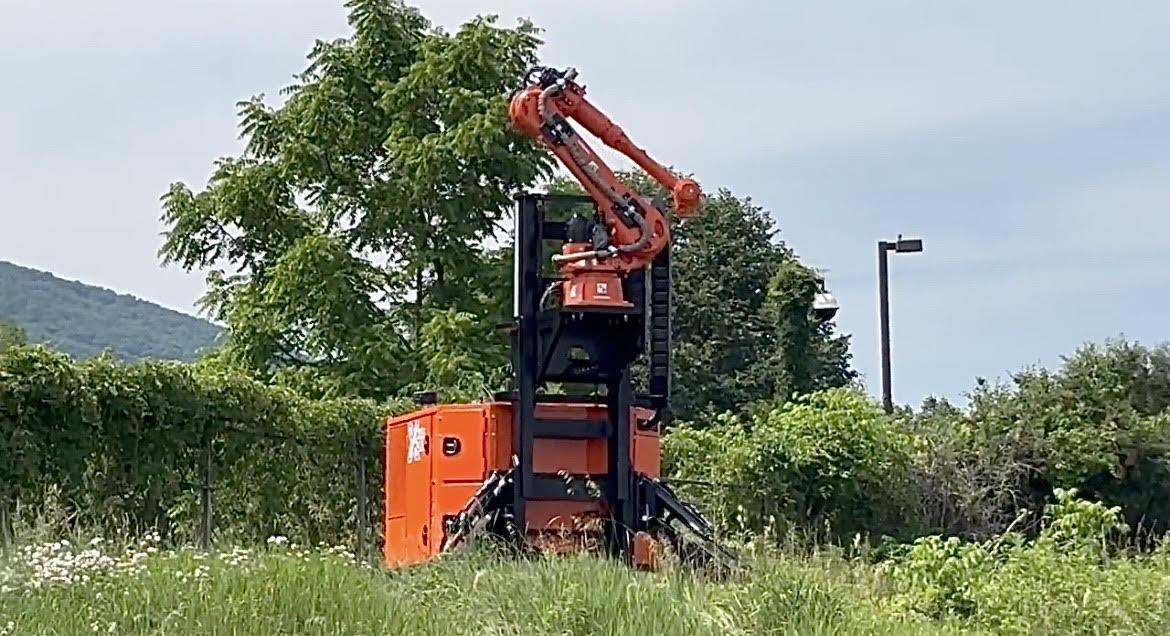
    X-Hab 3D’s new mobile, semi-autonomous, concrete printing system | Image Credits: Bruce Kraselsky LinkedIn

    In 2022, HappyValley Industry covered the beginnings of a startup that had recently found a home in CATO Park. X-Hab 3D, originally born from a NASA Centennial Challenge and the work of Penn State researchers, focuses on developing expeditionary-grade, mobile 3D concrete printers and, at the time of prior coverage, the company had received a DARPA grant to develop carbon-neutral material formulations for artificial reefs along coastlines. 

    We caught up with Bruce Kraselsky, co-founder and CEO of X-Hab 3D, to learn how the company has grown since and what’s on the horizon. 

    Pushing the edge on technology  

    According to Kraselsky, X-Hab 3D’s progress over the last two years has been “huge” and can be split into three categories: technology development, government R&D projects and showcase projects.  

    “We’ve taken the stationary robot technology that Penn State had developed… and we have taken that technology as a baseline, and developed, now, a complete, semi-autonomous, mobile self-powered robotic arm platform that can essentially move about the construction site on its own…built for operating on challenging terrains just about anywhere on the planet,” he said.

    X-Hab 3D’s new mobile, semi-autonomous, concrete printing system | Video Credits: Bruce Kraselsky LinkedIn

    X-Hab 3D has sold two of the units thus far, one to the Maryland Air National Guard, which will be able to deploy the unit to 3D print everything from barracks to runway repairs on remote islands. The other unit was sold to Alaskan nonprofit Extreme Habitats, where it will be used as part of a project to build rural, affordable housing and infrastructure.  

    Recently, the Maryland Air National Guard showcased their unit on the National Mall in Washington, D.C., and the other unit set to go to Alaska will be demonstrated over the summer before a test run will demonstrate how the unit can print materials to withstand the harsh Alaskan winters; afterward, the unit will be used to print a 1,200-square-foot house. 

    “We’re also going to be demonstrating the technology as it applies to agricultural products,” Kraselsky added. “We’re going to be showcasing the printer at Ag Progress [Days] at Penn State in August, and we’re building a 1,200-square-foot house in either the last quarter of this year or the first half of next year with Habitat for Humanity in Centre County.”  

    The potential for X-Hab 3D’s robotic products is extensive.  

    Kraselsky said, “The beauty of our mobile robot is that it really and truly could drive right through your fence, into your backyard, and it could print for you a, let’s say, if you had a skidsteer and the hole is dug, swimming pool. It could print yard furniture. It could print a small in-law house in your backyard if you wanted it to, and it would roll in under its own power. It could operate completely off the grid. It doesn’t even need an external power source to operate. You just need a barrel of water and the material, and we’re developing technology that will continue to reduce the size of the platform and increase the precision of the print. So, you’re not limited to concrete. You can print wood pulp. You could print chocolate with this thing.”  

    3D printed structure | Video Credits: Bruce Kraselsky LinkedIn

    He added, “The other thing is that it is a fully programmable robot, so you can take the 3D concrete printing nozzle off and replace it with a tool changer. There are a couple dozen things that you can do with this robot. You could spray-paint your house. You could weld.”  

    That said, the one challenge that Kraselsky said his team has come up against has been making all of the above “really, really simple” for the consumer. X-Hab 3D uses complex technology at the hardware, software and materials levels. However, they want to make their solutions so easy and simple to use that the customer feels as if they were purchasing a car — just drive it off the lot and you’ll more or less know what to do. 

    Growing deep roots in Centre County 

    Through all of this development and progress, though, Kraselsky said that the most exciting part of the last two years has been the collaborations made possible via the Happy Valley ecosystem and, more specifically, Penn State. 

    “We’ve pulled together an extraordinary team of scientists from Penn State and the surrounding area,” he said. “I have structural engineers on my team. I have a rockstar material scientists. I have computational designers and architectural engineers, all together. When you have all these different disciplines in one place, it’s a catalyst for innovation, and we’re really pushing the edge on technology. To me, that’s the most exciting part.”  

    He admitted it would be far more difficult to have achieved X-Hab 3D’s success thus far if the company had started anywhere else, and also mentioned how helpful it’s been to have a talent pool of Penn State graduates to pull from, as the business expands.  

    “It was absolutely the right decision to locate here,” he said.  

    When looking to the future, Kraselsky’s team sets its sights high with the goal of becoming the Caterpillar of 3D concrete printing systems. Five years from now, Kraselsky said, he sees X-Hab 3D as a multi-hundred-million dollar company, with an entire series of mobile robotic products for the construction industry, and an international footprint.  

    He summed up, “We are truly standing up a new industry sector in construction, and that means that we have to stand up an ecosystem for support, with Penn State and other Pennsylvania universities, along with Ben Franklin and our industrial partners that we’ve managed to pull together so far, at the core. We’re trying to use Pennsylvania in general and State College in particular as an anchor, where we grow deep roots. We want to build an ecosystem here and then build out from here, ultimately regionally, and then nationally and then globally. We think that the economic development opportunities, the academic growth opportunities and the technology opportunities for this area are huge for us, and they’re huge for Penn State. For the contracts that we’ve won with DARPA, NASA and HUD, Penn State is a subcontractor on all of them, and we’ve already, for example, with those contracts, contributed somewhere between $1 million and $2 million, back to Penn State, even as a startup.” 

  • The future leaders of Centre County: Centre County 4-H Robotics Club

    The future leaders of Centre County: Centre County 4-H Robotics Club

    by Brady Bast 

    CC4H’s presentation for Arts Fest Kid’s Day | Image Credits: HappyValley Industry.com

    In a local, 4,000-square-foot build facility, more than 100 Happy Valley students are laying the foundation for successful careers in STEM fields. These students, members of Centre County 4-H Robotics, will become the future leaders of Centre County, and will, upon graduation, be highly sought after by universities and STEM employers. 

    “Our primary goal is to provide an exceptional extracurricular STEM and leadership development experience not typically available in traditional school systems.” 

    Bill Gendron, a community volunteer mentor, explained: “Centre County 4-H Robotics is a Penn State Extension 4-H community STEM program that provides hands-on learning to students from 4th to 12th grade across Centre County. Our primary goal is to provide an exceptional extracurricular STEM and leadership development experience not typically available in traditional school systems.” 

    The club partners adult volunteer mentors with both STEM and professional skills with enthusiastic youth to build, program, test and drive robots in regional and global competitions. Students in the program learn a wide range of skills, including the design process, mechatronics, electronics, CAD and additive manufacturing, fabrication, software coding (primarily JAVA), systems integration, business development and leadership. The unique, hands-on approach helps students develop teamwork, leadership and relevant business skills. 

    CC4H invited local community to play with miniature robots on kid’s day | Image Credits: HappyValley Industry.com

    “Our projects focus on designing and building robots that meet the competition requirements of FIRST [Robotics], using age-appropriate technology,” Gendron described. “We compete in three divisions of FIRST Robotics Global Competitions: FIRST Lego League (FLL) for elementary school students, FIRST Tech Challenge (FTC) for middle school students and FIRST Robotics Competition (FRC) for high school students.” 

    “This program instills a strong sense of responsibility and a culture of giving back to the community.” 

    In 2018, the group’s high school team won the GLOBAL FIRST competition, outperforming thousands of teams worldwide. 

    “Winning competitions is a significant achievement,” Gendron noted. “But what’s more important is the real-world engineering challenges and teamwork experiences these students gain. This program instills a strong sense of responsibility and a culture of giving back to the community.” 

    One of several robots CC4H presented on Old Main Lawn | Image Credits: HappyValley Industry

    During the off-season summer months, the club is busy supporting various community outreach events, building a business team to handle business development activities and preparing for the upcoming competitive season starting in the fall, all while keeping an eye on their future goals, including growing student membership, increasing the number of adult mentors and boosting sponsorship support to expand their impact across Centre County. 

    “We’re always looking for more people to join our efforts,” Gendron said, “whether you’re a student, a mentor, or a sponsor…” 

    Learn more about Centre County 4-H Robotics and how the group not only equips students with technical skills, but also prepares them to become the next generation of leaders and innovators, making a lasting impact on the community:   


  • Filling demand in metal manufacturing trades

    Filling demand in metal manufacturing trades

    by Holly Riddle 

    We recently covered how the Central Pennsylvania Institute of Science and Technology (CPI) is helping to fill the gap between talent and industry in Happy Valley, preparing young talent for skilled trades and working to alleviate the skilled labor shortage. It’s not only CPI that’s making this effort within the region.  

    As of May, thanks to a $4.4 million investment from the Department of Defense and the Institute for Advanced Composites Manufacturing Innovation, Penn State is making a huge commitment to creating workforce development programs designed specifically to strengthen the U.S. casting and forging industries.  

    According to a university press release, “Nearly one-fourth of the manufacturing workforce is aged 55 years or older, according to the U.S. Census Bureau. By 2030, more than 2 million manufacturing jobs will be unfilled, according to the Manufacturing Institute. That lack of skilled workers is a concern for the Department of Defense, which relies heavily on cast and forged equipment.

    “The department has identified a need for at least 122,000 mission-critical manufacturing personnel by 2028.” 

    Image Credits: Penn State University News May 2024

    Penn State’s new three-year initiative — dubbed, Metallurgical Engineering Trades Apprenticeship and Learning program, or METAL — will bring together both the Penn State University Park and Behrend campuses and, if successful, make a dent in those numbers. The impact should be particularly felt at home, too:

    “The METAL program will build on Pennsylvania’s manufacturing base: Metal casting supports more than 30,000 jobs in the Commonwealth, according to the American Foundry Society. Those workers generate more than $6.7 billion in annual economic output.”  

    To learn more, we spoke with Penn State Professor Robert C. Voigt, from the Department of Industrial & Manufacturing Engineering. Along with his peers, Voigt will be working on developing some of METAL’s manufacturing teaching programs, which will include workshops and outreach events for K-12 students, hands-on manufacturing boot camps, certificate and apprenticeship programs and an online curriculum in metal manufacturing. 

    Since the whole point of METAL is to strengthen the metal casting and forging industries, tell us a little bit about what those industries mean for the average person. How do these industries impact someone’s day-to-day life?  

    The casting industry and the forging industry make complex critical components that are a part of automobiles, appliances and a lot of things…that are made with metal parts.

    “It’s a backbone silent industry, if you will. You don’t purchase the metal parts that [the industry makes] directly, but they’re a part of anything from iPhones to automobiles, kitchen appliances, lawnmowers, etc.”

    This industry, which used to be the backbone of American manufacturing, now also has international competition in countries across the world, so the metal casting industry and the forging industry are competing not just on the national stage, but on the worldwide stage. That’s okay if you’re making simple castings and forgings, but if you’re making complicated ones, and if you just need a few, you don’t want to go across the oceans to get these products.  

    In particular, our whole defense manufacturing supply chain is made up of components from U.S. [casting and forging] companies, so they’re the backbone of not only commercial things, but also all sorts of military products, too. 

    Why do you think that the talent shortage that this program is trying to alleviate exists? Why are more young people not getting into the casting and forging industries? 

    It’s just as simple as how starting decades ago, people started buying brand-name products and brand-name clothing. Now, these students have grown up, they go to our high schools and universities and they’re attracted to brand names. If you go to job fairs, you’ll find brand-name companies that sell things to the consumer — it could be Apple, Google, etc. — and long lines of students who think they want to work for those companies.  

    These [casting and forging] companies are more invisible. [Students] have never heard of some big casting and forging company, because they don’t sell products directly to the consumer, and so [the companies] suffer from that invisibility, for one thing.  

    I also think, when you make metal parts, it’s the kind of environment, in that factory, where you normally take your shower at the end of the day rather than at the beginning of the day. You’re going to be working with things that are heavy, things that are hot — but the amount of excitement that you have, the variability in job experiences and the opportunities are really outstanding.

    “Our goal is to show [students] some of those opportunities so that they understand that this is an exciting career.”

    Why is Penn State uniquely positioned to help fix this problem? 

    Penn State University has been involved and worked closely with the metal manufacturing industries, including casting and forging, from its very, very beginnings… There’s been a long line of foundry professors at Penn State, back into the 1800s.  

    In the forging industry, the companies are small and medium-sized companies, and they’ve been hiring Penn State engineers, historically, since the very, very beginning of metal manufacturing programs at Penn State.  

    We have wonderful laboratory facilities where we can, for example, melt metal at 3,000 degrees Fahrenheit and we can make metal castings and we can forge small products, and as part of our undergraduate engineering programs, we do teach these [skills] to our engineering students.  

    This is actually a unique program that combines Penn State University Park with Penn State Behrend. It’s exciting to work closely with them, in that corner of the state. I don’t think there’s ever been a bigger joint program between the two universities. 

    Tell us about the apprenticeship and certificate programs you’ll be working on. 

    Our programs, which have been [historically] focused on university engineering students, are now going to expand [as we] develop a curriculum that can be used for students who, when they graduate from high school, want to transition maybe to a university, maybe in engineering, maybe in business, maybe to a vocational training program — but these are all talent skill sets that these companies need. So, we’re trying to bring certificate programs and technology bootcamps to those students. It’s going to start here at Penn State, and we’re giving that curriculum to other universities and programs across the country.  

    We have some online early training activities that are going to be up and going in a month. We have week-long bootcamps, where we bring students into our lab and show them the technologies, give them the training. This is designed for anyone 18 years and older, getting them excited and potentially transitioning them directly to a job. We taught our first bootcamp in the spring. We’re teaching our second bootcamp in August, and we’ll continue to not only teach these boot camps, but also work with other universities and export [the bootcamps] to other universities as well. 

    [In the] apprenticeship and pre-apprenticeship-type programs, and skill-upgrading programs, we’re going to work with companies and develop a curriculum that can help us support the training that they already do. They already do training for their employees. It’s sometimes ad hoc, and we’re going to try to help coordinate and give them activities that can accelerate that training… By providing some of the curriculum for apprenticeships, we believe that these companies can link into support from the state and U.S. government to help train [talent], which will be key to keeping these industries vital for the next decades.  

    As Voigt summed up, METAL “is a magnificent partnership with small and medium-sized manufacturers, with  professional organizations or trade associations… and these educational opportunities, supported by defense manufacturing [and] the U.S. government, will really keep our industry strong, resilient, sustainable and affordable.” Learn more at https://iacmi.org/metal. 

  • Marketing Takes Flight with Indoor Drone Videos

    Marketing Takes Flight with Indoor Drone Videos

    by Brady Bast

    When it comes to skydiving, racing drones, and entrepreneurship, a little risk can often lead to a big reward.  

    Tyler Henderson began his professional career in 2014 as a videographer and editor for WPSU where he helped the production team earn 4 NATAS Mid-Atlantic Emmy’s over 5 years. Simultaneously, Henderson has been a skydiving instructor and freefall videographer since 2012, and a drone videographer since 2017. 

    After learning to fly drones as a teenager, he eventually earned his FAA commercial drone license to add production value to a growing freelance video business. However, simply flying the drones didn’t give Henderson the full video production control he was looking for. So, he started modifying and building them to go faster and carry larger cameras—which proved to be equal in fun to skydiving during winters off from the jump season.  

    As his drone skills developed, Henderson moved into a new role with the Penn State College of Engineering’s communications and marketing department. There, working with the team’s creative director, Kate Myers, he combined his indoor drone flight expertise and video production skills to develop multiple video projects highlighting campus facilities. This successful formula translated into a unique business opportunity: producing indoor drone videos using custom-built microdrones.  

    XHab 3D Drone Video | Watch here. 

    Earlier this year, Henderson and Myers partnered to found AmpliFLY Video. Myers, the brand’s creative director, has a rich background in advertising, marketing, and graphic design—making the duo a perfect team.  

    “Overwhelming support from the community” in just one hundred days  

    In addition to Henderson’s decade of experience building and flying drones, AmpliFLY Video adds their special sauce: immersive visual storytelling. The team collaborates with clients to create a strategy that drops viewers right into a desired setting, whether that is an office space, hotel, restaurant, or large, diverse facility. Henderson and Myers use a cost-effective, efficient process to capture video with small drones to highlight what it’s really like to be in a space, and in the middle of the action.  

    Clients include the Happy Valley LaunchBox Powered by PNC Bank, Gamble Mill Inn & Suites, X-Hab 3D, Origin Labs, the Nittany Valley Sports Centre, and Downtown State College, to name few.  

    PA Military Museum Video | Watch here. 

    Kate tells us, “Our goal is to create videos for our clients that are high-energy, navigate unexpected angles indoors, and include people to really highlight the vibe of a space. We can cover a lot of ground quickly, producing the kind of videos viewers are excited to watch, and rewatch. This approach contrasts with traditional drone videos that tend to fly over or through mostly empty areas. Having people involved brings the environment to life, and we’re able to do this thanks to the experience and expertise that Tyler brings to piloting drones.” 

    Gamble Mill Drone Video | Watch here.

    The two said they have received “overwhelming support from the community,” even though they have only been in business for just over one hundred days. As a two-person team, Myers and Henderson are being strategic about their growth. They plan to be selective about their projects and manage their pipeline effectively.  

    While they are just getting started, Henderson noted that the drone video productions are something they truly enjoy creating for clients, and they don’t plan on offloading it to a broader team just yet, saying, “I can’t believe I get to combine my love of film and flying drones together and call it work!”  

    Learn more about AmpliFLY Video at https://www.ampliflyvideo.com/.  


  • Penn State computer science students react to shrinking job market

    Penn State computer science students react to shrinking job market

    by Jodie Dello Stritto

    Jensen Huang, NVIDIA Founder, President & CEO told the World Governments Summit recently that programming and other complex fields can be handled by AI, leaving no reason for students to study computer science. Watch the clip. 


    Then, a recent story in the Wall Street Journal declared that while “computer science is hotter than ever at U.S. universities… students graduating this month are discovering their degrees are no longer a surefire ticket to tech-industry riches” and “many are finding it harder than they ever thought it would be to land a job.”  

    The article points out that once-growing tech companies are not hiring entry-level employees and even cutting jobs, in some cases relying more on AI. Postings for software developer positions on Indeed have dropped 30% compared to pre-Covid listings. Meanwhile, the number of computer and information science majors in the U.S. has increased by 40% in the last five years with more than 600,000 graduates in those majors in 2023. As such, “The pipeline is bursting with comp-sci students who will need jobs in the next few years.”   

    Mark these events as inflection points in the STEM world.  

    What do Penn State computer science majors think? We got reactions from three of them.  

    “Please start using AI”

    Let’s face it. The competition is real. As the article tells the market is more saturated than ever with comp sci majors and there is not a lot of room for new grads in the field. AI is booming and the skyrocketing stock price of NVIDIA is proof of the same. However, will AI make comp sci obsolete? Will AI replace us? Hardly. AI itself needs monitoring. It will make our lives easier. It might hurt some low-skill workers in the IT field. As the CEO of NVIDIA said in this video, please start using AI. It is not scary. It is just a large database of information that is here to help the human race innovate, thrive, and advance faster and more efficiently. On a side note, the tradesman profession is going to boom. This article gives us a glimpse.  

    Het Sheth ’26  


    “We need more innovators and ideators” 

    In my understanding of the computer science world and AI, I believe no doubt jobs in the computer science department will be affected by AI (for example how GPT 4-o can create webpages now) but the “HOW” people or inventors will always have jobs. It’s scary for students to rely 100% on school, as we need more innovators and ideators in the industry. Inside computer science, many different segments like cyber security and AI will create more jobs while maybe making other sections as obsolete. 

    As for me, I feel my computer science degree will aid me to help and fill technology-implementation gaps. Understanding the roots and basics of the upcoming technology drift will enable me to harness in the direction I want.  

    -Kanika Gupta ‘26 


    “Programmers working directly with AI can make a ton of money” 

    What I’ll say to this is that I believe that the current insanely competitive job market for software developers has more to do with the tech giants realizing that their development staff was bloated (with a lot of unproductive engineers), cutting a large portion of their workforce, and then having revenue data back up this assumption. This, combined with having more computer science students than ever all searching for jobs at the same time, is a far more prominent factor (today at least) than AI replacing programmers (not saying that that’s out of the question in the future, but it is absolutely not the case today).  

    Elon Musk himself set a precedent for other tech companies. He started running the show at Twitter and demanded all remote workers come back to the office, got rid of those who refused and still got rid of a ton of the workforce that was willing to come back. I remember reading all sorts of stuff online from Twitter devs who left as well as devs from other companies who talked about all the problems that Twitter would have because of this…but Twitter is going as strong as ever. This is how the free market works and as long as AI doesn’t replace us, it will sort itself out – programmers perhaps just can’t expect the insane salaries that they enjoyed throughout the 2010s to be commonplace anymore.  

    As the article said, programmers working directly with AI can make a ton of money still – but those jobs often require Ph.D.s or lots of experience in the field. As for what I plan to do…I think a lot of that will depend on how the next round of searching for internships goes. I am getting great hands-on fast-paced experience developing applications in my current internship – and getting involved with the whole process from front end to back end with some very marketable technologies, I have a 4.0 GPA and some solid references, so I feel as though I’ve set myself up pretty nicely for the coming internship season, and if it ends up being the same struggle as this year (minimal responses and companies generally not giving me the time of day) then perhaps I should start pondering other options.  

    David Lang ’26  


    What are your thoughts on the rise of AI and its impact on the computer science field? Tell us in the comments. 

  • Silicon on steroids

    by Holly Riddle

    In April, Penn State announced the formation of the Silicon Carbide Innovation Alliance (SCIA), “a coalition of industry leaders, academic institutions and government support with a focus on becoming the nation’s central hub for research, development and workforce training in SiC crystal technology.”

    The Alliance will be based out of the Penn State Material Research Institute and is just the latest example of the university’s dedication to excellence in materials research. That said, the Alliance isn’t just about research — it also will help fill a massive talent shortage, and bring industry opportunities to the Commonwealth. Furthermore, according to its director, the Alliance and the associated onsemi Silicon Carbide Crystal Center will be unlike anything else in the country, and like few other places in the world, and will include manufacturing processes that represent the most extreme environment on earth, heating graphite and SiC “sand” to temperatures that reach nearly half the temperature of the surface of the sun.

    Here’s what you need to know.

    Becoming the national centerpiece for silicon carbide material science

    For the average layperson who doesn’t know their silicon from their silicon carbide (two materials that are vastly different, according to the Alliance’s industry liaison officer, David Fecko), Alliance director Joshua Robinson gave us the quick definition.

    “Think of it as silicon on steroids,” he said. Silicon carbide is the material that will replace silicon in electric vehicles, electrical grid, and power electronics and, as silicon carbide is highly superior due to its efficiency, and it’s a material that will be necessary for the clean energy transition. In short, it’s the future.

    In fact, you probably have similar technology on your desk or in your pocket right now. If you have a fast-charging cell phone charger, components in that system are made with similar silicon-on-steroids technology Similarly, if you’ve ever used a Tesla Supercharger, you’ve experienced the power of silicon carbide.

    However, despite this superiority, efficiency and necessity, Robinson said that accessible U.S. research around silicon carbide crystal manufacturing had waned in recent history. So why was this the perfect time for Penn State to jump into a more or less abandoned area of academic research, focusing on manufacturing silicon carbide?

    Robinson explained: “It comes down to funding. Research goes where the money is. In the 90s and early 2000s, there was a significant amount of government funding to develop this material for defense applications… Companies then took the knowledge from that government investment and started commercializing it, developing it for LEDs and high-powered devices.”

    These companies focused on their own IP and silicon carbide remained an industry focus, rather than a research focus — and then the gray tsunami began. With more and more industry professionals retiring, and little research leading to workforce development and training, private industry realized it was coming upon a problem. Companies had worked hard to protect their IP, but now they had no trained workforce to work on that IP.

    The goal is to advance workforce development, educate our students and upskill or re-skill incumbent workers, so that they can move from oil and gas or from other industries, into this industry that is poised to to continue to grow at greater than 20% annually, to more than $20 billion by 2030. We want to be the national centerpiece for silicon carbide material science and engineering.”

    “Companies are struggling,” said Robinson. “There are companies that want to hire hundreds of people, and they just can’t find the workforce.” This is what brought a leading manufacturer, onsemi, to Penn State to establish the onsemi Silicon Carbide Crystal Center – a centerpiece of the Alliance.

    Providing this workforce is one of the new Alliance’s aims, as it creates workforce development opportunities for all levels, from certificates and two-year degrees on up, which includes developing partnerships with leading workforce providers like the Pennsylvania College of Technology.

    “If you look at the needs of the workforce, we are going to need four to five times the number of technicians than we are [individuals with] advanced degrees. These people running the tools, doing the measurements and collecting data — those are the ones we need a lot more of,” said Robinson.

    Another one of the Alliance’s aims is to bring in new industry partners and expand existing industry partnerships, such as Penn State’s long-standing partnership with Morgan Advanced Materials, which is now a founding Alliance partner.

    After achieving these goals, the overall result will impact not just Centre County, but the entire Commonwealth, and then the country.

    Robinson summed up, “The goal is to advance workforce development, educate our students and upskill or re-skill incumbent workers, so that they can move from oil and gas or from other industries, into this industry that is poised to to continue to grow at greater than 20% annually, to more than $20 billion by 2030. We want to be the national centerpiece for silicon carbide material science and engineering.”

    For now, the Alliance is renovating its facilities and prepping its curriculum to provide hands-on training, in anticipation of a more formal Q1 2025 kickoff, at which point it will begin research and training projects based on its industry members (industry members will be able to vote on the research projects the Alliance undertakes).

    To learn more and contact the Silicon Carbide Innovation Alliance, visit scia.psu.edu.

  • Getting more effective treatments to patients, faster

    Getting more effective treatments to patients, faster

    by Holly Riddle

    Penn State biomedical engineering doctoral candidate Josh Reynolds

    Each year, the Invent Penn State Summer Founders Program welcomes a handful of startups to participate in a one-of-a-kind entrepreneurial crash course. Over 13 weeks, startup founders work full-time to take their ventures to the next level, enjoying a range of Invent Penn State and Happy Valley LaunchBox powered by PNC Bank resources: a $15,000 grant for each startup, coaching sessions, intern assistance and more.

    We’re covering a few of the startups participating in the 2024 Summer Founders Program and, in fact, you may have already met one of them, if you caught our recent coverage of Saveware, a startup using AI to help businesses optimize sales tax refunds.

    Today, we’re looking at Atlas Biotech, a startup led by biomedical engineering doctoral candidate Joshua Reynolds. Reynolds participated in the HappyValley LaunchBox FastTrack Accelerator program last fall and, just last week, he received formal notice that Atlas Biotech had received a $2.4 million grant from the NCI. In other words, this is one startup poised for success.

    Tell us about what led you to create Atlas Biotech.

     I’ve been at Penn State for a while. I’m in the end of my seventh year. I did a master’s in biomedical engineering and then stuck around to do a PhD. I’ve been working in Dr. Justin Pritchard’s lab on campus, co-advised by Nikolay Dokholyan…in Hershey. About a year ago, we were working on this platform that can detect drug resistance to existing cancer therapeutics. We started thinking about how we could use that to try and predict resistance before we give drugs to a patient, and see if we could maybe help do a better job of selecting drugs for clinical trials and have more successful, more efficacious clinical trials. That was the impetus.

    Did you always think you would end up starting a company, as you were getting your master’s PhD?

    Definitely not. I think a lot of people…start out thinking academia is so exciting… You become pretty quickly disillusioned with the system, because it’s very challenging to navigate and it’s very competitive for grants, and it’s taxing. I learned pretty quickly on that I did not want to do academia, so I was looking at working in industry, trying to find a job somewhere at a company doing something cool.

    About a year ago…I got engaged and my fiancé has a couple years left in her PhD program, so I was like, ‘Hey, I’m going to be around a while. Why not look at what we can do here?’ It worked out nicely. There was this opportunity for early career academics to get funding for entrepreneurship, and I’ve always been interested in entrepreneurship…

    So, what does Atlas Biotech do, in the simplest terms?

    Our primary goal is to help pharmaceutical companies pick the drugs that they want to take to clinical trials and do a better job having successful clinical trials. That’s the primary goal, with the ultimate objective of getting better medicine to patients, faster.

    The clinical trial success rate right now is really poor. It’s about a 5–10% success rate in clinical trials. There’s a lot of room for improvement. That’s where we really see the value prop for companies… We have these assays, these screens, we’re developing that we’re hoping can do a better job helping people pick the more successful drugs prior to putting them into people. That’s the point at which there’s no going back.

    Why was this in particular something you wanted to pursue? Why were you the right person for the job?

     I went to Texas A&M for my undergrad, studying neuroscience. My grandfather passed away from lymphoma when I was in my junior year there, and that hit me pretty hard. I think [it] really gave me some perspective on how big of an issue cancer is. It’s impacted almost every single person I know. So, that motivated me. I don’t think I knew, at the time, consciously, that it did, but when I was looking for programs for a master’s or PhD, I was looking at cancer programs and people that were studying different forms of cancer.

    I’ve been working for, I think, five years at this point on this specific technology, and it’s been an endeavor, but we think we have something really useful.

    That’s how I ended up working on it for my master’s, and [Pritchard’s lab] really focuses a lot on drug resistance. That’s what my thesis is on — characterizing and trying to study and overcome drug resistance in cancer, because that’s the primary reason treatments fail and people pass away: drug resistance.

    I’ve been working for, I think, five years at this point on this specific technology, and it’s been an endeavor, but we think we have something really useful.

    What happens after the Summer Founders program ends? Where does the startup go from there?

    The [NCI] grant is for three years, so that’s a three-year runway to get the technology scaled up and see how it goes, try to engage potential clients and build up a customer base. That’s basically my next three years.

    In parallel, I do want to develop other technologies and try to identify market needs, and then meet those with new technologies… Developing these technologies obviously takes years, but I think we’re at a good point. Given the state of other technologies I’ve heard about in this kind of funding program, we’ re near the end of the validation of our tech… I’m looking to have commercial sales in the next two years, as my goal.

    Any advice for other Happy Valley startups?

     If you have an idea, something that you’re excited about, go for it. Go talk to the people at the LaunchBox. They’re excited to help. That’s their job. They live for that. I was overwhelmed with how encouraging and supportive everyone there was…Talk to one of the advisors there, and just see what they think. I’m sure that you’ll be supported and told the best path forward.

    Stay tuned for further coverage of this year’s Summer Founders program startups in the weeks ahead!

  • Using AI to help businesses optimize sales tax refunds

    Using AI to help businesses optimize sales tax refunds

    Next in line in our Penn State Startup Week coverage is Saveware, founded by Brady Davidson and Ryan Hokimi. Saveware is an AI-powered software that helps businesses optimize their sales tax refund processes.

    Saveware made a significant impact at Startup Week, and has made a significant impact on the Happy Valley entrepreneurial ecosystem overall. During Startup Week, Saveware won $15,000 at the Invent Penn State Inc.U Competition, and also $5,000 in the Happy Valley Venture Capital pitch competition. Saveware is also set to participate in the 13-week Invent Penn State Summer Founders Program, which came with a $15,000 grant.

    HappyValley Industry asked Davidson about the startup’s success thus far — and why two Penn State students have a passion for building a startup all about sales tax.

    I was seeing how lucrative these refunds were. I was seeing how much money the company I was working for was making, but how the processes were so inefficient. I had to explore a way to make them more efficient.

    Tell us a little bit about your and Hokimi’s backgrounds. What led you to creating Saveware? 

    I didn’t know [Hokimi] until this year. This past summer, I worked as an intern at a sales tax firm in the Harrisburg area. I was doing a lot of the same stuff every day, and thought what I was doing was a little bit outdated. With the implementation of some modern technology, it could be a lot more efficient. I came back to school with the idea of creating a computer program that could do what I was doing as an intern at this tax firm. I contacted Ryan, who was an executive for a big artificial intelligence club on campus. I have no technical skills and I was looking for someone who could program…

    He allowed me to enter a club competition they had, a Shark Tank-themed pitch competition, back in the fall. I ended up winning it with the idea of Saveware, with no progress [on it] at the time. Then, Ryan liked [the idea] so much that he…joined the team. I was more than willing to accept him. We’ve hit it off ever since. He has a lot of experience building AI products and has worked for a Y Combinator-backed startup, the biggest tech accelerator program in the world, basically. That’s how it all started.

    How did you end up participating in Inc.U and the Happy Valley Venture Capital pitch competition?

    Going to Penn State and being in the Innovation Hub building, everyone knows about Startup Week. We see all the posters, all the flyers, all the promotional media. We knew that there was serious money at stake. It could really accelerate us and keep us afloat…We were jumping at the bit to enter these competitions.

    I remember [Hokimi] and I worked for probably a week on just a three-minute video to submit, to try to get into Inc.U. It could’ve been the biggest waste of time ever. But, we ended up getting in. We were so happy.

    The day before the actual competition, we had to do a dry run. All the teams went up on stage and presented without an audience, to make sure all the technology was working, like our slide decks. [Hokimi] and I had a moment where we looked at each other, where, even if we won $0, we were really glad we did this… It put some pressure on us to work a little bit harder. One of our big selling points was that we had three paying clients. We showed real momentum. I think it made a difference in terms of the judge’s decisions for us.

    It sounds like this has been a lot of work thus far. Why is this something you care about — sales tax refunds?

    It’s not like I’m extremely interested in sales tax. I’m not captivated by the world of sales tax. However, working at my internship, there were parts that I liked. Obviously, I didn’t hate the job — but I hated how inefficient I felt my work was. I would be going through physical stacks of paper invoices, one by one, thousands of them, one at a time, analyzing them.

    I just didn’t think… this was the right way to do it. I don’t think there needs to be a person actually doing this work. I was seeing how lucrative these refunds were. I was seeing how much money the company I was working for was making, but how the processes were so inefficient. I had to explore a way to make them more efficient.

    There’s a lot of controversy around AI right now. Why is Saveware a perfect example of how to use AI?

    We’ve gotten this question a fair amount. There are two ways I’ll answer this.

    The first is, we’re putting money back in the business owners’ pockets. A lot of the people go after the fact that, oh, AI is eliminating jobs — but the way we see it is, with smaller companies, the refunds aren’t going to be as large, but if we are able to get a small chain pizza shop a couple thousand dollars, and that’s the difference between them having to shut down and them being able to operate for another year, that’s amazing. That’s a great thing that we think we’re going to be able to do in the next couple of months and years.

    The other side is, for the accountants that Saveware would be “replacing,” this isn’t, for the most part, their entire jobs. This isn’t something that they go into work every day and do. This is a menial task that they’re forced to do on the side, that they’re not looking forward to. If we can speed that process up and get them back to doing the more important work that is actually a good use of their time, we think that’s a perfect place to fit into the market.

    Stay tuned for more coverage of this year’s groundbreaking Startup Week innovators and changemakers!