As we close 2024 and step into 2025, organizations across Happy Valley have unveiled their strategic plans, highlighting a future rich with technological innovation and community development. Here, we explore the transformative path that Happy Valley is embarking upon, aiming to redefine its economic, educational, and social landscapes.
A Hub of Research and Development
At the heart of Happy Valley’s future is its commitment to becoming a premier center for research and innovation. Leading this charge are institutions like Penn State’s Applied Research Laboratories (ARL), with significant advances anticipated in sectors such as advanced manufacturing, aerospace, and defense. The integration of artificial intelligence and machine learning is poised to significantly enhance productivity and global competitiveness.
Thriving Through Tech Transfer and Commercialization
Tech transfer is crucial in transforming research breakthroughs into market-ready innovations. The region’s focus on nurturing high-tech startups, particularly in sustainable technologies and AI-driven analytics, is expected to bear fruit in 2025. Innovations like X-Hab 3D’s 3D printing solutions for construction are just the beginning. Supported by robust investments from private equity, Ben Franklin, and the College Township Industrial Development Authority, along with proactive state policies, we foresee a surge in entrepreneurial ventures that will stimulate economic growth and job creation.
Happy Valley as the Sensor and Chromatography Capital
With ambitious plans to become the sensor and chromatography capital of the world, Happy Valley is targeting a niche yet essential technology area. Sensors are crucial across a spectrum of applications, from healthcare to autonomous vehicles. As the demand for real-time data and connectivity grows, Happy Valley’s strategic focus on sensor technology is both timely and visionary. This specialization is set to position the region as an indispensable player in the tech-driven future. See the https://centrecountyforward.com/wp-content/uploads/2024/10/2024-Centre-County-Economic-Development-Strategic-Plan.pdf
Celebrating Regional Connectivity and Scenic Commutes: The I-99 Technology Highway
The natural configuration of Happy Valley and the surrounding Alleghenies as a unified region highlights the area’s strategic planning. The ease of commuting from nearby cities like Bedford, Altoona, and Lewistown, ranging from 20 minutes to an hour’s drive, underscores a significant advantage. These scenic commutes enhance quality of life and reflect the robust, interconnected nature of our community. This regional cohesion is expected to attract more professionals, enhancing Happy Valley’s vibrancy and appeal. Over 55% of people who work in Centre County commute from the region. The mindset and strategy tied to the boundaries of county lines are over. Your reaction to that statement is a quick assessment if you have a fixed or growth mindset. Consumers, businesses, and tourists all consider this a region spanning eight counties.
Online Learning Trends Impacting Campus Dynamics
Notably, the most rapidly filled classes at Penn State are now the online versions, even among students residing in Happy Valley. This shift in student preference is critical feedback, indicating a strong demand for flexibility in learning modalities. The university has responded by accelerating the development of hybrid and fully online programs, catering to new preferences while maintaining educational quality. This trend not only affects classroom dynamics but also influences campus resource allocation and long-term educational strategies.
The Hybrid Impact: Transience and Community Engagement
As the residential requirements in time decrease, the student body may become more transient, spending less time physically on campus. This shift will necessitate a reimagining of student engagement and campus community building. Universities will need to develop dynamic programming and support systems that cater to a more fluid student presence, ensuring that even short-term residents feel a strong sense of community and connection.
A Touristy, Vibrant Cultural and Commercial Community
The reduction in traditional residential time on campus (yes, more students are coming next fall than ever as branch campuses decrease) is likely to transform parts of the university town into more tourist-oriented locales, especially as the presence of attractions like our professional NFL-like football team, and all sports, especially wrestling and basketball, and major entertainment events draw visitors from beyond the student population. Happy Valley can expect an increase in short-term accommodations (see all the new hotels and more coming), eateries, and leisure activities that cater to a mix of students, tourists, alums, parents, and digital nomads. This shift will not only change the economic landscape of the area but also its cultural vibe, making it an even more vibrant and eclectic community.
Lifelong Learning and a Retirement Haven
The growing trend of lifelong learning, coupled with Happy Valley’s appeal as a retirement destination, adds another layer to its transformation. Many Penn State alums choose to retire here, drawn by the excellent entertainment options and the outdoor adventures that also make Happy Valley a favorite for their visiting families. This demographic shift supports a vibrant, year-round community of engaged, active seniors who contribute to the local economy and social fabric. OLLI at Penn State will continue to thrive as Penn State continues to support lifelong learning and offer new credentials in all departments.
The Road Ahead
The strategic visions laid out by organizations in Happy Valley paint a picture of a region on the cusp of significant transformation. It is exciting to see the strategic visions for Happy Valley Nonprofits like Centre Foundation indeed play a crucial role in connecting the community and driving positive change. Here is their new Strategic Plan: https://centrefoundation.org/what-we-do/current-initiatives/
The investments in technology, infrastructure, and community development made today are paving the way for a prosperous tomorrow. As these plans unfold, Happy Valley is expected to not only adapt but thrive as a modern, inclusive, and technologically advanced community.
With the advent of AI, the pace of change is set to be breathtaking. As consumers increasingly embrace online and hybrid educational models, the transformation across Happy Valley must not only adapt but also capitalize on these emerging trends promptly.
At HappyValleyIndustry.com, we are committed to being at the forefront of this transformation. We will continue to provide insightful analysis, report on developments, and foster dialogue among stakeholders to ensure that as Happy Valley evolves, it benefits everyone—residents, visitors, and all who cherish this vibrant area.
As we embrace 2025, the future is not just arriving; it is being shaped here in Happy Valley. Let us move forward with anticipation and readiness to embrace the opportunities that lie ahead.
We would love to hear your take on 2025 and our future. Please send your comments and insights to Jodie@affinityconnection.com.
Additive manufacturing (AM), also known as 3D printing, is the process of using a digital model to fabricate objects layer by layer by adding materials, including metals, ceramics and composites. Unlike traditional manufacturing methods, which typically involve subtracting material from a larger piece (by cutting or machining), AM builds objects from the ground up.
AM has many benefits for manufacturers, including its ability to create complex internal and external geometries and provide rapid prototyping and customization options. However, there are also disadvantages. AM has traditionally offered a more limited build volume than traditional manufacturing methods, it can be expensive because of the cost of the specialized equipment and it can be wasteful when parts have to be discarded due to distortion, cracking or material failure.
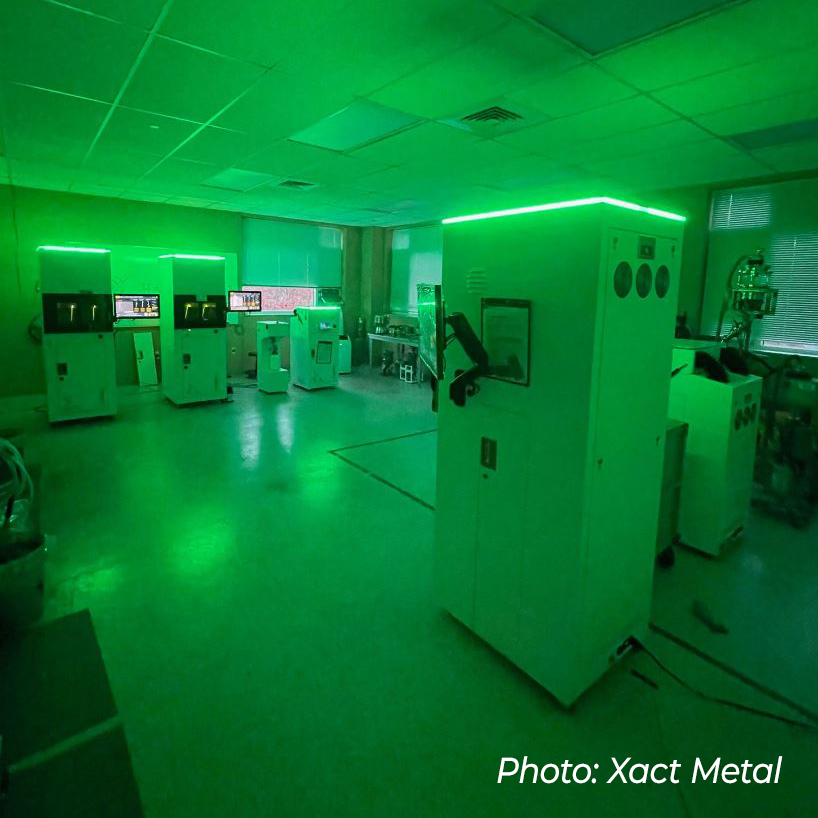
For Xact Metal, it’s critical that its metal powder-bed fusion (PBF) printers faithfully execute the designs its customers require — and that’s where PanOptimization’s innovative PanX software comes into play.
“At Xact Metal, we’re establishing a new level of price and performance in metal 3D printing by taking the essential specs of metal additive manufacturing and combining them with breakthrough technology,” said Juan Mario Gomez, CEO of Xact Metal, in a press release on Sept. 9, 2024. “We are pleased to partner with PanOptimization to bring cutting-edge simulation and optimization into the additive manufacturing industry.”
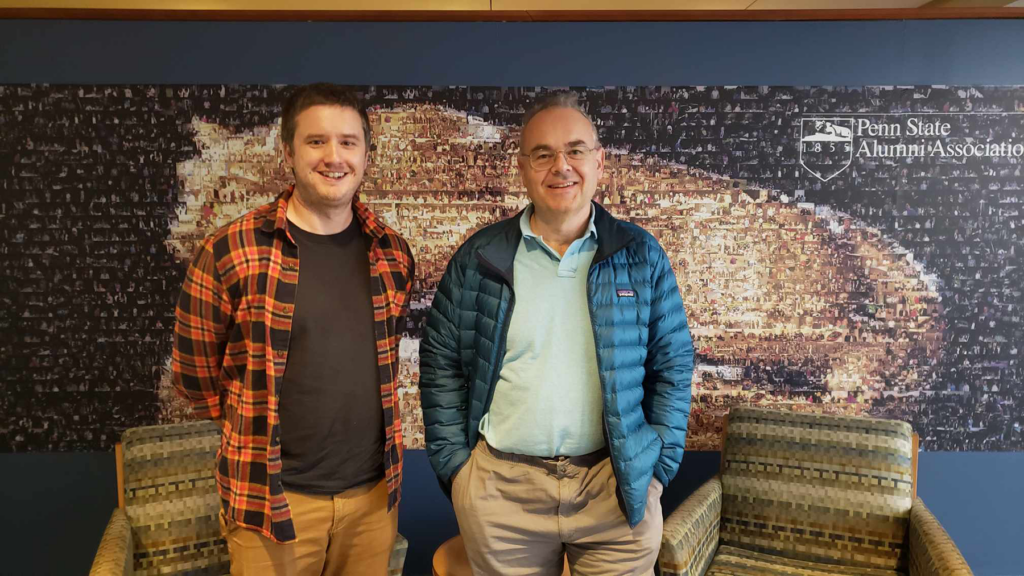
PanOptimization was founded by Pan Michaleris, CEO, a former professor in the Department of Mechanical and Nuclear Engineering at Penn State, and his former Ph.D. student, Erik Denlinger, Chief Engineer. The two had also worked together at Michaleris’ previous company, Pan Computing LLC. While Pan Computing focused on AM process simulation, PanOptimization takes simulation and optimization to a new level.
Predicting and improving the future
Erik Denlinger (L) and Pan Michaleris (R) of PanOptimization (Credit: Carmen Bilén)
“The new software’s objective is to not only just predict but actually improve the future.”
“The previous business was to predict the future,” said Michaleris. “The new software’s objective is to not only just predict but actually improve the future… predict the outcome but also come up with suggestions as to what you have to do to solve technical problems.”
The PanX software helps companies like Xact Metal by identifying and helping to mitigate thermal and mechanical printing challenges, predicting how various metals will behave during the AM process and pre-compensating for the behavior of the material in the design – making it far more likely that the design will print as anticipated and avoid costly failure.
“Our software… in essence, it’s like a virtual experiment.”
“Our software… in essence, it’s like a virtual experiment. Rather than spend $100,000 to build this component, let’s build it virtually and see what happens,” said Michaleris. “[The] objective of this business is to tell you how to improve the design.”
“If you try to build a shape like [a cup], it’s not going to turn out in that shape,” explained Denlinger. “It will actually warp and distort as you build it because things get really hot, cool down, things distort, they build up high stress… there’s a lot of components to the response of a part that can make it fail during manufacturing [and make it] not able to perform its end use.”
“It’s not just that we can do it faster or more accurate, it’s that nobody else can even do it.”
“The old software that we had, there were a lot of competing solutions on the market,” he added. “The software was good but it’s not nearly what we have today… If we run a simulation in our new software, if probably runs 100 times faster for their parts than our old one… The new solution is so much more scalable than the old way that we used to solve the problem… it’s not just that we can do it faster or more accurate, it’s that nobody else can even do it.”
“Right now, it’s the only game in town, I’d say,” Michaleris concurred.
Working together was a logical next step for PanOptimization and Xact Metal. The two companies are located just down the hall from each other in Innovation Park at Penn State, and Michaleris and Denlinger have known Gomez for years. The release of PanX in August 2023, however, was what ultimately led to the two companies’ partnership.
A mutually beneficial partnership
“They get the new software here and immediately they say ‘oh man, we can hit it right though a hundred designs on this thing overnight,’ ” said Denlinger. “This is so much better than building the physical thing that this is a complete no-brainer, so this is kind of what jump-started the engagement. Even though we’ve known each other for so long, it didn’t really start getting rolling until we had this new solver, because the value proposition is just so painfully clear to anybody in the industry.”
Learning together
Gomez is enthusiastic about the benefits of the partnership for his company.
“[We] have used PanX to help us improve the performance of our systems, understand the behavior of the metals that we work with and optimize the parts that we are printing to achieve the geometric performance that we require,” said Gomez. “We ourselves have seen the value that PanOptimization’s software provides and want to bring this benefit to our manufacturing customers, such as those in the injection molding industry, supported through our sales network of over 26 partners around the world.”
Denlinger also sees tremendous value in the relationship with Xact Metals in terms of both feedback on the software and the prospect of expanding PanOptimization’s client base.
“On the technical side, we get a lot of valuable insights from them — what’s easy for them to do versus what’s harder,” he explained. “[They] may measure something and say ‘the model didn’t capture this effect as well as it does other things, can you take a look at this,’ so we kind of learn together.”
“Juan Mario is pretty well connected in the industry, he knows a lot of people, so he constantly tells people about PanOptimization’s products,” said Denlinger. “He’s like the marketing arm of PanOptimization at this point.”
Photo: PanOptimization
See the Xact Metal and PanOptimization websites for more information about their products and services.
Carmen Bilén is a freelance writer and associate director of Engineering Career Resources & Employer Relations at Penn State. She can be reached at cpb10@psu.edu.
The Innovative Manufacturers’ Center (IMC) is dedicated to advancing the manufacturing community. The organization helps manufacturers with technological investments, people investments and any other needs that will help them to improve their operations.
“We work only with manufacturers to help them improve productivity, efficiency and quality.”
“We work only with manufacturers to help them improve productivity, efficiency and quality,” IMC President Dennis Gilbert explained in a previous interview for HappyValley Industry.
A manufacturing site. | Image Credits: Hans M. via Flickr
Who are the IMC’s primary clientele?
The IMC primarily focuses on the area’s entrepreneurs, regardless of their size. It has worked with small businesses and larger entities within the manufacturing community to help them navigate productivity investments.
“I think a lot of times we would think of entrepreneurs as more of a solo-preneur, someone who is a singular person or maybe a couple partners or something like that,” Gilbert explained. “A lot of our work, of course, is with manufacturing companies and so we would often work with the executive level in those companies.”
At what stage in the business process should entrepreneurs connect?
Entrepreneurs should reach out to the Innovative Manufacturers’ Center at any stage of their business journey. Whether they are launching a startup, seeking to scale operations or needing to adapt to changing market conditions, the IMC can assist.
The organization often works with businesses that are experiencing significant growth or requiring major capital equipment investments. Conversely, they also support companies facing challenges, such as downsizing or diversifying their operations.
IMC can be a valuable business partner. | Image Credits: Flazingo Photos via Flickr
What can entrepreneurs expect to gain from partnering with the Innovative Manufacturers’ Center?
“Growth,” Gilbert emphasized. “How can we make this more profitable? How can we make more? How can we produce more efficiently?”
“Growth. How can we make this more profitable? How can we make more? How can we produce more efficiently?”
With the IMC, entrepreneurs can expect to achieve enhanced profitability and operational efficiency. Whether they are looking to produce more effectively, invest in technology or adapt to market demands, the IMC’s services are designed to help them succeed and thrive in the competitive manufacturing landscape.
“The IMC is here to empower manufacturers at every stage of their journey. By focusing on tailored solutions for productivity and efficiency, we aim to elevate the manufacturing community as a whole. Whether you’re starting out or seeking to innovate, we’re ready to partner with you for growth,” said Gilbert.
Greg Woodman was named Young Entrepreneur of the Year for the State of Pennsylvania by the SBA in 1984, for his company HappyValley Promotions founded as a college student in 1981. Left to right: Former Penn State President Bryce Jordan, Greg Woodman, Lt Governor Scranton and SBA representative and Congressman Clinger.
By Greg Woodman
I’ve always had a passion for being a champion of Happy Valley, from founding HappyValley Promotions in the 1980s to now, delivering the latest issue of HappyValley Industry Catalyst.
HappyValley Industry’s mission is to accentuate the overwhelming benefits of this place where we live and work. Our goal is not only to shine a spotlight on positive progress, but also to highlight the local services and suppliers whose solutions are working behind the scenes to make it happen. Why am I so passionate about marketing these local businesses that I have been willing to do it for free in my own publication?
Here’s why: misconceptions about marketing are inhibiting the potential of many local businesses. They believe marketing is about advertising or selling. This limited view can lead to missed opportunities and even business decline.
I’ve counted four big misconceptions that are impeding many growth for many businesses.
#1: Marketing is just promotion
Many companies reduce marketing to just Promotion — running ads, creating social media content or sending out PR. While important, these are just the tip of the iceberg. Marketing is about aligning Product, Price, Place, and Promotion.
At Airwalk Footwear, where I was part of the team that drove 10x growth, the key was not just cool ads. It was understanding the skaters’ lifestyle (Product), pricing our shoes to compete in both niche and mainstream markets (Price) and expanding our distribution beyond skate shops (Place).
The Promotion worked because it was part of a strategy where all four Ps were aligned. This integrated approach was what allowed Airwalk to grow faster than competitors like Vans and Skechers at the time.
#2: Efficiency is more important than effectiveness
Many companies, especially those who run with a product-first mindset, often shift over time to focus on efficiency rather than effectiveness. This is where things go wrong. Companies that prioritize efficiency over effectiveness often lose their customer obsession — one of the key principles that companies like Amazon are built on.
Marketing, when done right, ensures that you are both effective and efficient. When companies focus too much on making operations more efficient and forget about customer insights, they miss the chance to innovate and grow. That is when the balance is lost. If one of the four Ps — let us say Product or Price — is not aligned with what the customer wants, it is like driving on a flat tire. The other Ps will not save you.
At Salvage Direct, where we scaled from startup to a $29 million sale, we did not rely solely on promoting our service. We revolutionized how customers bought salvaged vehicles online (Place), set pricing that matched both buyers and sellers, and built a product that solved real problems in the marketplace. Promotion only came after we had aligned across the board. This is what led to our exponential growth, not a flashy logo or a viral campaign.
#3: Companies can be successful without customer obsession
Amazon is a perfect example of how marketing, when done right, ensures you remain both customer-obsessed and operationally efficient. In Amazon’s model, marketing has a seat at the strategy table. They use customer data to drive decisions around Product (what to offer), Price (what is the sweet spot), Place (how to deliver), and finally, Promotion (how to communicate that value).
Most businesses in Central PA that I have worked with silo marketing to just Promotion. The result? Innovation stalls, effectiveness decreases, and efficiency becomes a hollow metric. When marketing is isolated, you lose the ability to truly understand your customer and the power to drive company-wide decisions.
When marketing’s influence on Product, Price and Place is lost, one P starts crushing the others, and that is when the business falters. It is like ignoring early symptoms of cancer — by the time the problem shows up in your metrics, it is often too late to reverse.
#4: Marketing doesn’t need all 4 Ps
In every major success I have been part of — whether it was Airwalk, Salvage Direct or various capital campaigns that raised millions — the same formula held true: Marketing worked because it was aligned with all four Ps.
At the State College Area School District Educational Foundation, a concept that we were a part of the startup of a new non-profit, the approach was not just about promoting a cause. The team built a product (mission) that resonated with donors, set accessible ways to contribute (place), and ensured that pricing (donation levels) aligned with what our community could afford. Once that strategy was nailed then story and promotion began. This led to $3 million raised from scratch. Alignment of all Ps is what enabled this, not just clever promotions.
Why I Created HappyValleyIndustry.com
All of this leads into why I created HappyValley Industry. I see something extraordinary in this region — potential far beyond what I encountered even with a company like Airwalk. Central Pennsylvania has everything it needs to thrive, but there is one thing missing: Marketing.
Not marketing in the way most people think — ads, logos, social media posts. I am talking about true marketing, where the 4 Ps — Product, Price, Place and Promotion — are aligned. Only when these elements are working in harmony can real, sustainable growth happen. Once aligned, then we can promote — using all the tactics that people often mistake as the entirety of marketing.
I want to be part of aligning those 4 Ps for the businesses here in the region. I want to see them grow, just like I helped grow Airwalk and other companies with which I have been involved.
We have all read the economic growth report that outlines where the region could go. It is an informative read and validated for me my investment in a website and 52 eletters and three print publications named “Catalyst” tied to the same goal of the report: GROWTH. I have read these kinds of reports at Airwalk and with many nonprofits and companies I have worked with hire us to do such reports. We call them Integrated Marketing Audits. But reading and even paying for reports does not create growth — alignment and action do. The report validated the need for alignment, leadership and action. Count HappyValley Industry and my team in.
HappyValleyIndustry.com was built as a marketing concept and platform with one goal — growth for the region via growth of the businesses in the region. The mission is to help guide local businesses to understand that the 4th P — Promotion — on its own is worthless. It is only when Product, Price and Place are also aligned that promotion becomes powerful.
Let’s talk.
If you are seeking growth for your business or nonprofit, I would love to chat. I believe that if you feel like your company is not hitting its full potential, it is because one of the Ps is out of alignment — and I would be happy to help you figure out which one.
Reach out, and let us discuss how Affinity Connection, a true marketing company — not just a promotion company — and our 4th P tactical promotion e-letter and website, HappyValleyIndustry.com, can support your growth goals. Let us make sure all four tires are pumped up and aligned for 10x growth!
Sensors make many aspects of modern daily life possible.
You begin your morning by checking the calendar on your smartphone to find the day’s appointments. The phone’s touchscreen is a capacitive sensor that uses materials like indium-tin oxide to respond to the touch of your finger.
You realize you have a check-up at the doctor’s today. You get into your car and back down the driveway, when suddenly you hear a loud beep alerting you that a dog that has run ahead of its owner and into the path of your car. That alert was possible due to ultrasonic sensors located on your car’s fender.
When you arrive at the doctor’s office, the sonographer uses ultrasound equipment to check the progress of a pregnancy or to locate a suspicious mass.
Broadly speaking, a sensor, also called a transducer, responds to inputs from the physical environment — such as pressure, temperature or light — and converts these inputs into electrical signals that can be used by a system to provide useful information, either on its own or in combination with other sensors. Modern sensors rely on advanced materials at their heart, such as piezoelectric sensors, which use piezoelectric crystals or ceramics to generate electric signals. When the doctor applies the ultrasonic wand to your body, it sends out a signal and then measures the reflection — similar to a radar, but with sound.
“Materials Valley”
The Pennsylvania Alleghenies is home to many companies that produce, utilize and integrate materials-related sensors for a variety of industries, including oil and gas, steel production, non-destructive measurement and medical technology. In fact, there is such a concentration of materials-related research in Happy Valley specifically that it has been referred to as “Materials Valley.”
Why is this area a hot spot for this type of work?
The biggest reason is proximity to Penn State University Park, with its wealth of experienced faculty, researchers and research facilities. Penn State is the No. 1-ranked materials science and No. 2-ranked materials engineering institution in the country. The Department of Materials Science and Engineering (MatSE) in the College of Earth and Mineral Sciences, for example, is an international leader in materials education and research. MatSE faculty and students conduct groundbreaking materials research through the department’s centers and labs, including the Materials Research Institute’s Center for Dielectrics and Piezoelectrics, a joint venture between Penn State and North Carolina State University.
One sensor materials company that has its roots in Penn State’s materials research facilities is Philipsburg-based PolyK Technologies, which makes specialty piezoelectric films for piezo sensor companies both locally and around the world and provides consulting and integration services for their products.
“The density of [these] companies is very high… it’s a very strong ecosystem of companies with specialization in ultrasound technology, from materials to components like transducers.”
The company was founded by Shihai Zhang, a Penn State MatSE alumnus who got his Ph.D. in polymer sciences in 2003. PolyK Technologies has grown since its founding to encompass 40,000 square feet of research and development space in both State College and Philipsburg and now has 13 employees. PolyK Technologies’ piezo materials serve a variety of markets including ultrasonic analysis, bioinformatics, non-destructive testing, traffic monitoring and security.
Piezoelectric sensors are also a key component of ultrasonic testing technology such as that used by TechKnowServ, a State College-based company whose president, Thomas Hay, received his Ph.D. in engineering mechanics from Penn State’s College of Engineering. TechKnowServ (TKS) provides advanced and conventional non-destructive testing services and expertise in acoustic emission testing, phased array ultrasonic testing (PAUT), guided wave ultrasonic testing (GWUT) and magnetic flux leakage (MFL). Ultrasonic sensing technology has many real-world applications for the oil and gas, transportation, steel and medical technology industries.
Ultrasound sensing technology is the core business for Pascal Ultrasound, an Innovation Park-based company founded in January 2024 — albeit with a little different focus. Pascal Ultrasound doesn’t produce the sensors themselves but rather provides ultrasound system integration solutions to help other businesses — mainly early-stage companies — to pull together the components that they need to make ultrasound transducers work.
“Ultrasound is normally used to generate medical images with ultrasound and, in those systems, ultrasound is used to extract information from the body and transform it to an anatomical image,” explains Alessandro Gubbini, founder and president of Pascal Ultrasound, “and then that process can be applied to industrial applications like nondestructive testing, so in all cases that equipment needs to generate ultrasonic waves and it does that using dedicated electronic circuits connected to transducers that emit ultrasound.”
“The Pennsylvania Alleghenies, with Penn State as a strong engine for the research and exploitation of novel materials, and a local ecosystem ready to commercialize those materials into sensors, will be at the forefront of the future.”
“What I’ve found through my experience in the industry, especially the last few years as a consultant, was that suppliers of all these components are fragmented,” Gubbini continues. “Companies need to source these components from different vendors, so that’s where the system integration component comes in… there aren’t that many companies that do integration.”
He added, “With Pascal, I’m integrating all the components that go into ultrasound-based products – electronics, transducers [and] connections between the two.”
Strong local ecosystem
Gubbini, who has worked in the region for more than 20 years and also has a consulting business called Soundflair LLC in addition to Pascal Ultrasound, has deep connections with materials research at Penn State, with local entrepreneurs through the Startup Leadership Network and Invent Penn State, and with local sensor companies including Sound Technology, Inc. (now part of GE), where he used to work. He says one of the best things about being located in the region is the “local ecosystem of ultrasound” that exists here.
“Actually, in State College or in general Happy Valley, I call it ‘Ultrasound Transducer Valley’ because there are many companies that deal with these types of components, especially transducers”, says Gubbini.“The density of [these] companies is very high… it’s a very strong ecosystem of companies with specialization in ultrasound technology, from materials to components like transducers.”
One thing is clear: Our modern lives will require new and innovative sensor technologies to push forward all kinds of consumer devices and industrial technologies. And those new sensors will require novel materials and manufacturing methods. The Pennsylvania Alleghenies, with Penn State as a strong engine for the research and exploitation of novel materials, and a local ecosystem ready to commercialize those materials into sensors, will be at the forefront of the future.
Carmen Bilén is a freelance writer and associate director of Engineering Career Resources & Employer Relations at Penn State. She can be reached at cpb10@psu.edu.
Photo, Looking up High Street toward the Centre County Courthouse – Bellefonte, PA. Photo by Jon Dawson, Flickr
By Holly Riddle
This morning, a crowd of community changemakers gathered to kick off a new era of economic prosperity in Happy Valley. At The Penn Stater, the Chamber of Business & Industry in Centre County (CBICC) unveiled its much-anticipated, new Economic Development Strategic Plan, an ambitious, multi-faceted roadmap for enhancing the region’s economy through business retention and expansion, bringing in new industries and business to the area, workforce development and livability enhancements.
You can read the full plan here, but we also spoke with the CBICC’s Greg Scott, president and CEO, and Todd Dolbin, vice president of economic development, to learn more about the plan’s specifics. For example:
Why now? Why is this the right time for Happy Valley to make a change?
With such a robust entrepreneurial ecosystem, why are small businesses leaving Happy Valley faster than they’re being born?
Is it really possible to bring new air traffic to Happy Valley? Or to solve the regional childcare crisis?
Find out their takes on this and more, below.
Tell me about the “aha” moment that spurred this plan’s creation. What made you think “we need this now and now is the time to do it”?
Greg Scott: We started thinking about this years ago. Some things had to come together before we launched into it, but coming out of the pandemic, there were a lot of headwinds that not only our community, but lots of communities had to deal with, in terms of, where do you go? We were experiencing a population decline, a little bit of workforce instability and certainly infrastructure challenges. When we look at Centre County and the region, there are so many good things happening here. We have an incredible opportunity right now to harness our unique strengths to continue to thrive as a community, become more competitive and reach our full economic potential.
“When we look at Centre County and the region, there are so many good things happening here. We have an incredible opportunity right now to harness our unique strengths to continue to thrive as a community, become more competitive and reach our full economic potential.”
Building off of that, we looked across the many different organizations that are doing good work in the realm of economic development in the county. However, there wasn’t a sense that they were all working toward the same purpose, or rowing the boat in the same direction. We saw a real opportunity to take a leadership role in economic development and do some strategic planning, something that hasn’t been done here in Centre County for more than 20 years. There hasn’t been this level of collaborative, community-wide planning that looks at what are we and what can we be, and what are the things that we can do specifically to move us toward the future.
That was the moment we said, “We need to provide a plan, something that’s future-looking that can be very clear and strategic in what we want to do.”
Hopefully, this plan — and we feel very optimistic about it — energizes the community to work together toward common goals and this common vision that we have created. We think it’s the right thing to do, and we’re excited about where we are today and what’s set up going forward.
Why do you think achieving the kinds of goals this plan sets forth has not been achievable in the past? What’s held Happy Valley back?
Greg Scott: I believe that there wasn’t this level of planning done for one reason: We are a very stable community. There’s this sense that things are good and people ask, “Why do we need to focus on this?” There wasn’t a great deal of pressure put on the community to look and say, “Oh, we’ve really got to take this to the next level.” I think we sit in this bubble where we’re okay. We have this great foundation from the university. We have great healthcare systems and we have some government entities that support our economy through jobs.
Two, I think when we think about all of these organizations that could be involved in an economic development or community development plan, there was a bit of siloing. People were just working in their lanes and doing good work, but not looking outside of that, because there wasn’t an entity that said, “Let’s broaden this view and see where there’s alignment among organizations doing this type of work.”
This strategic plan encompasses initiatives that stretch over multiple years. What is the most immediate noticeable change that the community can anticipate?
Greg Scott: The thing that I’m hopeful people will notice is this sense of team, this sense of partnership that has been developed in the community as we put this plan together.
“Then, as we think about how our action items and goals can be achieved, that will be done through partnership and collaboration. It’s not CBICC doing the actions and then reporting to the community. This is the community taking the action and moving it forward.”
Then, as we think about how our action items and goals can be achieved, that will be done through partnership and collaboration. It’s not CBICC doing the actions and then reporting to the community. This is the community taking the action and moving it forward.
I think the biggest thing that the community will see is this sense and spirit of collaboration and teamwork that has been developing and cultivated over the last year, as this plan has been put together. We’ve been out talking to the community businesses and organizations about this plan and what it means. People are getting energized about it and they want to be involved — and that’s what we want to see.
The plan refers to the area’s labor force stability challenge and mentions a planned talent attraction campaign; what will that look like and how do you plan to make the area more desirable to young talent?
Todd Dolbin: A big part of our plan lies within our emerging industries. One of the industries we’ve identified, the sensor technology sector, is one that we really hope to grow. With that comes opportunities for a lot of young talent trying to grow in an industry that has a very strong, emerging future. So, our plan for talent retention is working with the university, trying to retain some of the students, to work in these emerging industries.
Also, we’re already looking into possible resources like RoleCall and PeopleScout that other areas across the country use for talent attraction and talent retention.
Lastly, we’re establishing a brand narrative that we’re targeting young professionals by highlighting new business opportunities for these emerging industries and our high quality of life.
Beyond sensors, are there any other industries you specifically have an eye on? Any thoughts on the potential for Materials Science, chromatography or higher ed disruption companies?
Todd Dolbin: Yes. We have ultrasound, chromatography, analytical lab monitoring equipment — which could be considered a subset of sensor research — all the incredible work with materials science on campus, critical minerals, rare earth minerals, materials, semiconductors, chip research, ag tech… Those are all major, major advantages that we have.
With all that being said, we do have to prioritize. You have to start somewhere. We can’t tackle everything all at once, right from the beginning. That’s why we’re targeting sensors, because we already know a lot of companies have already expressed interest in trying to put together this industry cluster. That’s where we’re really starting as step one. Hopefully, looking down the road, yes, we’d love to expand that, but I think sensors and ultrasound chromatography will probably be first.
On top of that, the university has been really leaning into those industries as well, so having the strong businesses, the university’s research pairs very well with why we’ve chosen that.
Lastly, our goal is to align it with the state’s economic plan. In that plan, they’ve identified industry sectors in which they as a state want to grow — ag tech, robotics, healthcare, manufacturing… The sensor industry cuts across and is extremely valuable for all of those industries, so as the state’s trying to grow those industries, the sensor industry that we have right here in Centre County and Central Pennsylvania will be a very critical component to those industries’ growth.
The report noted that small businesses in the area are dying faster than they’re being born. With such a robust entrepreneurial ecosystem in Happy Valley, why is this the case and how will that be remedied?
Todd Dolbin: That was very surprising to a lot of us, but it was good to learn. One key finding in the beginning of the project was that Centre County has a low share of young businesses compared to similar regions with a major university anchor, and that we do have a higher rate of startups exiting the local market, then entering it. We’re trying to understand why that is, and we’ve been seeing that some of the issues may be that there’s a limited access to capital, and, as they’re needing to grow here locally, other small business and entrepreneurs can’t find startup services to help sustain them long-term.
“For things like business plan writing or financial support, [we have resources here], but having [those resources] coordinated and accessible for the startups is extremely important. I think we’ll really try to grow that level of technical assistance. We’ll aim to formalize this multi-organizational concierge service, so that regardless of how a startup or small business interacts with any of our resource partners, each one is a front door for all of our other organizations.”
For things like business plan writing or financial support, [we have resources here], but having [those resources] coordinated and accessible for the startups is extremely important. I think we’ll really try to grow that level of technical assistance. We’ll aim to formalize this multi-organizational concierge service, so that regardless of how a startup or small business interacts with any of our resource partners, each one is a front door for all of our other organizations.
Our partners at the Office of Entrepreneurship and Commercialization at the Penn State Innovation Hub have really taken a big step in pulling groups together, like the Chamber, Happy Valley LaunchBox, the Penn State SBDC, Ben Franklin Technology Partners, College Township and the Downtown State College Improvement District. We’re meeting very regularly to get a better understanding of exactly what all of our services are and how we can work together, and identify what gaps there are between all of our services. Then, we can start identifying what we can do to better service our local entrepreneurs.
There are two big livability and business issues that the plan recognized, and they’re two that I hear about often when talking to Happy Valley employees: lack of childcare and lack of flights. These are pretty big, seemingly difficult problems to solve. How specifically will these be addressed?
Todd Dolbin: Well, if there was an easy answer, they probably would’ve been solved by now, and it’s not just us here. The childcare issue is nationwide and many regional airports are having the same issues.
In terms of childcare, yes, that can be a huge barrier for talent attraction and also employee retention. A big part of what we’re doing in the business retention expansion effort is get the full information from some of our major employers. One key piece of that is understanding what their challenges are and hopefully identifying that, if childcare is in fact a major obstacle or challenge for them, what we can do to work closer with childcare providers or local state officials to identify more state federal programs, and really educate ourselves about what resources are available, and be creative in what we can do to support childcare needs.
I think that many people have expressed concerns about the lack of flight options in and out of State College. One action that we’re considering, and this is something in early stages, is really a plan to coordinate an initiative to attract new airline service through target marketing that promotes incentives. We’re also bringing together some of our partners locally so we can work with the airport to see what data they need, what our community’s travel needs are, what resources the airport needs, and what messaging we need to work on, so we can get our airport back on the radar for major airlines. How do we get noticed, so that when airlines are starting to grow and look to reestablish regional flights, we’re top of the list for some of those major carriers?
In establishing a new regional brand identity, what’s the vision? How do you want to newly position Centre County? Will this new brand identity only apply to Centre County, considering how many people live in a surrounding county and travel in for work?
Todd Dolbin: We are excited for the opportunities this plan presents for us to expand our brand regionally, especially since a lot of our workforce commutes in from outside our county border. This plan aims to develop our unified brand that targets different audiences and promotes our county’s values and identity.
“We have a brand. People know Centre County and Penn State and Happy Valley. What we’d like to do is really have a unified brand that targets different audiences.”
We have a brand. People know Centre County and Penn State and Happy Valley. What we’d like to do is really have a unified brand that targets different audiences. For example, have a really clear message for businesses, for attracting residents, job seekers, families, entrepreneurs. We’re really lucky to have a large Penn State alumni network that we can also reach out to, to show them that we have a lot of other great, quality of life amenities here… It’s really developing a common message. We know all of our strengths. It’s developing a strong brand identity so we can then attract high level talent.
Greg Scott: We’re not looking to establish a new brand. We have a brand to build on. It’s about how do we refine that message? What are we known for? We’re not looking for a new tagline or to get rid of Happy Valley or strip Penn State from what our brand is. All these things are good. It’s, how do we package it up? How do we promote who we are? We just don’t have something to give to companies or talent to say “This is who we are and this is why it’s great to be here in Happy Valley.” There are pieces of it, but it’s not consolidated. We want to be clear about who we are.
Out of all of the details covered in the plan, what would you say should be the biggest takeaway for (1) small business owners, (2) for large companies/organizations looking to relocate/establish a new location and (3) the average Centre Countian?
Greg Scott: I think the plan reinforces the foundation that we have here in Centre County. This is a great place for small businesses, for large businesses, for people to live, whether you’re a remote worker, a family… There are great characteristics and we have that to build on. I think the big takeaway is, in all of these various circles, we have an opportunity to partner and collaborate [in a way] that helps each of these circles.
“This is a great place for small businesses, for large businesses, for people to live, whether you’re a remote worker, a family… There are great characteristics and we have that to build on.”
If we have collaboration and partnerships where we’re able to create better opportunities for resources to be available, small businesses can be successful. Those entrepreneurs can survive the first two years of their business launch.
“We’re going to lean into attracting and retaining businesses of all sizes, breaking down our siloes and focusing on true collaboration across our community. A win in one area is a win for all of us in the county and the region.“
We’re going to lean into attracting and retaining businesses of all sizes, breaking down our siloes and focusing on true collaboration across our community. A win in one area is a win for all of us in the county and the region.
“Economic development is community development. There are many aspects of the work we do that are not just focused on creating jobs and creating additional tax revenue. It is about creating the opportunity for improved quality of life for everybody that lives in our county.”
Then, how does this impact the average person living in the county? Economic development is community development. There are many aspects of the work we do that are not just focused on creating jobs and creating additional tax revenue. It is about creating the opportunity for improved quality of life for everybody that lives in our county. Leveraging outdoor rec and having a safe place to live, having good healthcare facilities — all of that weaves itself into community development and economic development. I think that’s what we are trying to stimulate with this plan.
Looking at the possibilities that could come out of this plan, what are you personally most excited about?
Greg Scott: Centre County is a great place for businesses of all sizes, people of all ages and workers in all industries. What we have here is a community that has all the potential to work together and to think about all the different roles we will have in moving this plan along. I’m excited to see how that evolves and translates to results and action.
The ARM Group has assisted Blair County’s Greenfield Township Municipal Authority (GTMA) with the development of a groundwater supply well. | Image Credits: ARM Group Enterprises
By Sarah Taylor
In the heart of Happy Valley, two companies are leading the charge in delivering innovative solutions tailored to meet the diverse needs of their clients: ARM Group Enterprises and the Innovative Manufacturers’ Center.
ARM Group Enterprises offers a comprehensive suite of services, including environmental consulting, engineering design, remediation services and electrical automation. The company was founded to address the pressing need for innovative and sustainable approaches in environmental remediation and engineering projects.
With a vision focused on growth and making a positive impact in Happy Valley, ARM Group is dedicated to high-quality service delivery that benefits both the environment and the community. Key clientele include municipalities, industrial facilities, real estate developers and government agencies.
“Our agility in responding to changing market needs, coupled with our focus on quality and client satisfaction, ensures our success in Happy Valley and beyond.”
“Our agility in responding to changing market needs, coupled with our focus on quality and client satisfaction, ensures our success in Happy Valley and beyond,” Wendy Pelky, vice president, shared.
“Our dedication to sustainability and community involvement strongly aligns with the values held by Happy Valley residents,” she added.
Like the ARM Group, the Innovative Manufacturers Center (IMC) is dedicated to making an impact in the local community. The center has been a steadfast backer of small to mid-sized manufacturers for over 35 years. The organization believes that the manufacturing industry offers sustaining jobs and opportunities for the local region.
“IMC has a great past; the future is even brighter. When our clients succeed, we succeed.”
“IMC has a great past; the future is even brighter. When our clients succeed, we succeed,” President Dennis Gilbert proudly shared.
The center specializes in helping businesses grow and thrive by providing five business development advisors dedicated to assisting local manufacturers in navigating challenges and seizing opportunities. The Innovative Manufacturers Center is actively engaged with roughly 400 companies, which underscores the organization’s commitment to fostering industry growth.
Both companies recognize the unique opportunities that lie within Happy Valley. ARM Group’s diverse service offerings and technical expertise enable it to adapt to changing market needs, ensuring success in the region. Similarly, IMC’s long-standing history and focus on client success position the organization favorably for continued growth.
The counties within the Innovative Manufacturers’ Center’s service area. | Image Credits: IMC
Together, ARM Group Enterprises and IMC exemplify how innovative solutions can lead to sustainable growth, benefitting not only clients but also the broader community of Happy Valley. Their commitment to excellence and community aligns perfectly with the values held by residents and stakeholders, creating a promising outlook for the future.
Learn more about the ARM Group Enterprises here and the Innovative Manufacturers Center here. If you enjoyed this story, sign up for HappyValley Industry’s free weekly newsletters, covering all things industry, innovation and entrepreneurship in this incredible local region.
Sarah Taylor is a communications professional studying telecommunications at Penn State University. She can be reached at sarah.st.taylor@gmail.com.
Penn State’s 2024 Materials Day is coming up! Materials Day is an event that connects Penn State talent with companies and shares Penn State’s latest research and discovery with industry, government and service partners.
The event is designed to share Penn State’s vast materials research knowledge and infrastructure with industrial and government research and service partners, so attendance is critical if you’re looking to stay abreast of Penn State Materials news or if you are looking to identify graduating students for future positions.
Materials Day is also focused on interaction and discussion among attendees. Industry reps can talk with students and faculty about their company, creating connections and visibility that benefit the company as they announce job openings or come to career fairs.
Attending companies can also see what faculty are working on, leading to potential research collaborations or connections with graduating students. In addition to the external collaborations, Materials Day is also a chance for Penn State groups to collaborate internally form teams to apply for grants and proposals.
As David Fecko, director of industry research collaborations at Penn State’s Materials Research Institute, said, “Penn State is one of the leading universities in the country in terms of Materials Research. Materials Day is a great way to get an overview of all of the great programs and research projects that are happening at this moment in time. As with all large universities, the programs, students and even faculty tend to turn over every few years, so even if you have attended Materials Day in the past, you will find something new and interesting this fall. Current programs that are going through significant change are all semiconductor research areas, materials impacting the medical fields and sustainability and critical minerals and materials.Come and let us show you all the things that we are working on!”
2024 Materials Day When: Oct. 29–30, 2024 Where: HUB-Robeson Center and the Millennium Science Complex, University Park, PA Registration:www.mri.psu.edu/mri/events/2024-materials-day
Check out some of the highlights from a previous Materials Day!
Video: Penn State Materials Research Institute (MRI) / Seana Wood
Phospholutions, a sustainable fertilizer company committed to creating technology-based solutions for food production and environmental challenges by enhancing the efficiency of phosphorus use, is a Happy Valley startup success story — and a perfect example of how the Happy Valley entrepreneurial ecosystem can provide multiple, simultaneous resources that prop up such success.
As we’ve reported in the past, founder Hunter Swisher began his entrepreneurial journey as a Penn State student. With support from Ben Franklin Technology Partners and Penn State, he launched his business before graduation.
“[Ben Franklin] has been working with Hunter literally since day zero,” said Todd Erdley, program manager with Ben Franklin Technology Partners. “Hunter participated in our TechCelerator Programin fall 2016.”
Ben Franklin’s support for Phospholutions has showcased a full engagement of the organization’s three pillars: Knowledge, Networking and Funding, said Erdley.
“Hunter and the Phospholutions team have used our full suite of transformation services, ranging from market research to HR to accounting to marketing,” he said. “[Ben Franklin] has also provided key introductions for the team that have been impactful on all levels of the business.
“Finally, [Ben Franklin] has provided multiple investments to include the largest single investment we have ever provided,” Erdley added.
This multi-tiered collaboration led to the development and launch of Phospholution’s RhizoSorb®, a fertilizer technology that increases nutrient use efficiency, cutting costs for farmers and reducing the environmental impact of phosphorus fertilizers. As the first fertilizer technology on the market proven to reduce phosphorus use by as much as 50% while improving grower yields, RhizoSorb is setting a new industry standard for phosphorus efficiency.
“Integrating RhizoSorb into fertilizer production makes it more economical and feasible for farmers to use,” Swisher explained. The company recently announced the results of a study proving that the product reduces runoff potential by 78% compared to conventional phosphorus fertilizers.
Now, Swisher oversees a management team of eight executives who lead a company employing 28 staff members. Under his leadership, the startup has garnered support from the agricultural technology sector and secured investments of more than $30 million in venture capital.
As the most recent example of Phospholution’s use of Happy Valley entrepreneurial and Penn State resources, Phospholutions signed a memorandum of understanding (MOU) with the Penn State College of Agricultural Sciences, as a commitment to furthering their collaboration in research and education. The partnership creates a framework for the two entities to explore shared interests and underscores the college’s commitment to translating research into impactful solutions, said Blair Siegfried, the college’s associate dean for research and graduate education.
“The MOU not only helps to make the work of our faculty and scientists available to growers and helps protect our natural resources, it also provides our graduate students with opportunities for industry experience,” Siegfried said. “It may also lead to partnerships with other industries that will result in opportunities for sponsored research.”
“The partnership with Penn State’s College of Agricultural Sciences represents a win–win–win,” said Erdley. “It’s a win for Phospholutions and its ability to continue developing cutting-edge technology. It’s a win for Penn State to showcase public/private partnership that can rapidly build upon the success of both Penn State and Phospholutions. And it’s a win for Pennsylvania to have this amazing research lab developing technology and solutions that will fuel additional entrepreneurial outcomes and drive economic impact to our Commonwealth.”
“It’s a win for Pennsylvania to have this amazing research lab developing technology and solutions that will fuel additional entrepreneurial outcomes and drive economic impact to our Commonwealth.”
“We continue to support Phospholutions thanks in large part to Hunter’s vision and willingness to both learn and share his knowledge,” Erdley concluded. “We will support his team as they continue to make an impact on our planet through decreased reliance on phosphorous.”
Siegfried acknowledged the mutual benefits of having the resources and innovative capabilities of local companies such as Phospholutions at the university’s disposal.
“We are committed to creating an environment where companies can access a well-trained and educated workforce that makes historic innovations in agriculture,” he said. “We are also committed to helping the local economy by making our research accessible to those who really need it. Our strategic partnership with Phospholutions is a great place to start.”
Bev Molnar is a freelance writer and a public relations specialist at Penn State University Libraries. She can be reached at bgs3@psu.edu.