Category: Innovation Park

  • How to keep investing in CX – even during economic uncertainty

    How to keep investing in CX – even during economic uncertainty

    Ben Franklin Technology Partners of Central and Northern PA is hosting a free, in-person session featuring Dave Seybold, CEO of TTEC Digital, as he discusses the importance of investing in customer experience, especially during times of uncertainty.

    The event will include an afternoon of discussion, light refreshments and networking with other entrepreneurs, students, faculty and small businesses in the State College area.

    About the session

    In 2022, customer experience passed price and product as the core value driver for businesses. To be successful in today’s experience-driven economy, brands must invest in the interactions — the experiences — customers have with their brand. However, because today’s customers interact with brands across so many channels, many companies struggle to identify where to invest in customer experience so that they realize real, tangible benefits.

    The truth is that you can activate multiple channels faster than ever before, and there’s a crucial moment to focus on within each channel — the conversation. In this presentation, we will discuss why focusing on conversation can drive revenue and results — especially during times of economic uncertainty.

    About the speaker

    Dave Seybold is a dynamic and proven leader who brings more than 30 years of global expertise partnering with clients to design and implement technology solutions at scale. He is inspired by creating business value using digital cloud technologies and leading diverse, global teams, and has held senior executive leadership positions at IBM, Avanade, Atos and TTEC while living in Bangalore, Madrid and the United States.

    Event Info

    Date: April 4, 2023

    Time: 2:00 – 4:00 PM with light refreshments and networking

    Location: Penn State Innovation Park, 200 Innovation Blvd Room #243, State College

    Cost: Free

    Registration: Please RSVP to Michelle Cook at mac80@psu.edu by March 28.

  • Virolock’s mission? Prevent pandemics by trapping and identifying viruses quickly and easily

    Virolock’s mission? Prevent pandemics by trapping and identifying viruses quickly and easily

    By Stephanie Kalina-Metzger

    Scanning electron micrograph (SEM) of tomato spotted wilt virus trapped in a CNT microfluidic device. False blue color was added manually.

    There’s always new, cutting-edge technology in the works at Penn State. One of the more recent developments involves a group of Penn State professors working with scientists on solutions to identify and capture viruses. Virolock is led by President Mauricio Terrones, Ph.D., with co-founders Nestor Perea-Lopez, Ph.D., and Yin-Ting Yeh, Ph.D.

    Terrones said that Virolock’s current work centers on growing carbon nanotubes (CNTS) in a lab. This involves passing a hydrocarbon vapor through a tube furnace assisted by a catalyst material that is high enough in temperature to decompose the hydrocarbon. CNTS grow over the catalyst and CNTS grow over the substrate containing a patterned catalyst.

    “We’re trying to detect viruses in the air in a crowded room, in restaurants, hospitals, student unions and may be able, at some point, to detect a new, emergent virus almost immediately and take action.”

    “The idea is to use CNTs to block particles of specific sizes. For example, Covid and flu viruses are around 100-130 nanometers in diameter,” he said.

    Cutting-edge technology with unprecedented accuracy

    Out of this work emerged a hand-held device that captures viruses based on size, from samples thought to contain viruses.

    After growing the CNTs, Virolock collaborated with scientists to create a diagnostic tool to rapidly trap and identify viruses using a laser beam and a detector, with a technique called Raman Spectroscopy. Raman spectroscopy is a process where viruses are identified by shining a light on a disposable cartridge that collects samples from a patient’s saliva taken with a cotton swab, or a person blowing through a device called a microfluidic cartridge.

    Once a sample is collected, a spectrometer measures vibrations that result from shining a light on the collected vibrations. “Each virus has its own signature vibrations,” said Terrones, adding that influenza, for instance, would have a different signature vibration than, say, coronavirus.

    “Within two minutes, a person would know if they have a respiratory virus by comparing the result of the spectroscopy test with other results in the database.”

    “We then use Raman spectroscopy to identify the viruses based on their individual vibration,” said Terrones.

    Right now, the most common type of test for coronavirus takes several hours and is uncomfortable. Samples are obtained by sliding a swab into the nose or throat.

    “With this new technology, you collect the sample, pass it through the device, shine a laser on the surface of the material and that will give you the fingerprint of the virus. You could detect one virus, or multiple viruses,” said Terrones, adding that every time a sample is collected, it can be stored in a database.

    According to Terrones, an identification will take less than two minutes, with an accuracy rate of 70 to 90%, compared to today’s state-of-the-art microbiology techniques.

    Terrones explained this technology is cutting-edge partially due to the lack of antibodies needed. “Right now, the tools people use to detect viruses need antibodies. We don’t. Keep in mind that using antibodies relegates us to identifying just one virus. With our technique, we can trap and study them all,” said Perea-Lopez.

    Raman spectroscopy — both novel and viable

    Terrones, remarking on coronavirus, stresses the importance of rapid and accurate detection.

    “Raman spectroscopy has not only the potential to help with coronavirus, but also other illnesses, like the flu, to halt disease spread. It has the potential to save hundreds of thousands of lives a year,” he said, adding that it differs from both immune and molecular-based methods, which require prior knowledge of the strains. The Raman technique, on the other hand, can detect several different viruses at once, making the technique both novel and viable.

    Federal funding

    The Virolock team is reaching out to the federal government to demonstrate that its technology works to detect Coivd-19, so that the team can eventually build prototypes that can be scaled up for mass production and field deployment.

    “We see this technology eventually becoming available to anyone visiting their family doctor. Within two minutes, a person would know if they have a respiratory virus by comparing the result of the spectroscopy test with other results in the database,” said Terrones, adding that the technology could one day be installed in hospitals, commercial aircrafts and airports.

    Ongoing research

    Otherwise, the team at Virolock is working on ways to halt future pandemics, according to Terrones.

    “We’re trying to detect viruses in the air in a crowded room, in restaurants, hospitals, student unions and may be able, at some point, to detect a new, emergent virus almost immediately and take action,” Terrones said.

    “Raman spectroscopy has not only the potential to help with coronavirus, but also other illnesses, like the flu, to halt disease spread. It has the potential to save hundreds of thousands of lives a year.”

    The team also foresees establishing a center for virus surveillance to address the issue of virus trajectories, expanding that to animals as well.

    “I see this technology lending itself to farming, since farm animals get diseases like avian flu and crops are even affected by viruses,” said Perea-Lopez.

    “We even learned that deer were affected by COVID. That means it was circulating among the deer and can mutate in a different way. If you can monitor all these things in real time, you can make a tremendous difference, which is our goal and we are proud that Penn State is leading the way when it comes to virus detection,” added Terrones.

  • Medical simulation startup uses robotics to train for better patient outcomes

    Medical simulation startup uses robotics to train for better patient outcomes

    By Stephanie Kalina-Metzger

    Three “Dynamic Haptic Robotic Trainer” systems lined up and ready to train medical residents at Cedars Sinai Medical Center in Los Angeles. Photo: Provided.

    Engineers are naturally problem solvers and, as such, are often pioneers of innovation. Those who choose to become professors don’t always stop inventing. Take the case of Scarlett Miller and Jason Moore. Both are professors of engineering at Penn State who identified a problem and adopted a goal to fix it through a Happy Valley-based business they founded called Medulate.

    “We combined our expertise and examined the impact that training played in the medical profession,” said Miller.

    Through advanced engineering, we have the potential to positively impact patient safety.”

    What Miller and Moore discovered through doctor interviews is that central venous catheterization was a top issue when it came to human error. For those unfamiliar with the term, central venous catheterization is when a catheter is placed into a large vein to deliver fluids, deliver medication or take samples. Central lines are generally placed in a large vein in the neck, upper chest or groin. Also ranking high in human error was needling, from subcutaneous (under the skin), to percutaneous (passing through the skin) and IV injections.

    The pair discovered during their research that medical professionals who performed needling less than 50 times were prone to error. This led the team to the conclusion that the problem could be traced back to surgical training, which in turn, led to the development of Medulate.

    “What we learned is that the procedure is simple when you’ve done it a lot, but the biggest burden is learning how to do it on a patient. There’s a steep learning curve when a real patient isn’t being worked on,” said Miller.

    Moore, who oversees the Precision Medical Instrument Design Lab, used his experience with robotics to begin designing new training technology.

    Introducing the LT100 and LT2000

    According to Moore, Medulate’s resulting LT100 simulator now trains medical professionals on percutaneous and subcutaneous needling procedures, as well as IV injections, by providing haptic feedback to mimic forces inside the human body. Students receive data on the accuracy of needle placement, the angle of insertion and the steadiness of that insertion. The training is self- guided, eliminating the cost of an instructor and offering feedback on performance over time.

    The LT2000 simulator further replicates ultrasound-guided central line placement using 50 unique patient profiles. As the software also gives feedback over time, students can track their performance.

    Miller said that the simulators are a win-win for both the patients and the users to reduce failed insertion attempts and offer something that a cadaver can’t, which is feedback.

    Help from within and without

    But the simulators and research needed to get Medulate off the ground were expensive, so Miller and Moore went searching for outside funding from a variety of sources. In 2015, the pair received an R01 grant from the National Institute of Health, which is awarded for mature research projects that are hypothesis-driven via strong preliminary data. Those who win the grants receive up to five years of support, with a budget that reflects the costs required to complete the project. This NIH R01 grant was renewed in 2019.

    “What we learned is that the procedure is simple when you’ve done it a lot, but the biggest burden is learning how to do it on a patient. There’s a steep learning curve when a real patient isn’t being worked on.”

    Penn State, in an effort to support its College of Engineering faculty entrepreneurs, also helped the project along by awarding Miller and Moore an ENGINE grant, to assist them in developing their simulation training idea through a partnership with Hershey professor Dr. Sanjib Adhikary. In 2019, the pair went on to compete in the Ben Franklin Technology Partners TechCelerator program, which helps startups de-risk their business ventures. After pitching their idea to a panel of judges, they went home with the top prize of $10,000.

    Making an impact

    Looking to the future, Miller and Moore hope that their simulators will end up being the gold standard when it comes to ensuring that medical students are effectively and inexpensively trained.

    “The thing that motivates us most about Medulate is the impact we can have on human lives. Through advanced engineering, we have the potential to positively impact patient safety,” said Miller.

  • Giving first responders next-gen solutions to today’s emergencies

    Giving first responders next-gen solutions to today’s emergencies

    By Stephanie Kalina-Metzger

    ERTCA partner TECHLINE Technologies demonstrates methods for applying a loss-of-limb tourniquet at ERTCA event in Bradford County, PA. Photo: Provided.

    Eric Porterfield, CEO of the Emergency Response Training and Certification Association (ERTCA), a nonprofit housed at Innovation Park, credits a grant from the Ben Franklin Technology Center for helping him jumpstart his Distance Learning Network (DLN) — a business that laid the foundation for his current initiatives.

    “DLN was a satellite-based, continuing education company focused on mental health and grew from 17 viewers in 1997, to 45,000 in seven years, making it one of the largest paybacks in the history of the Ben Franklin Technology Partners program,” said Porterfield.

    DLN’s weekly viewership delivered continuing education over the noon hour to doctors, nurses and therapists and spanned a total of 50 states before being purchased by the United Health Group. Then, Porterfield was called on to attend a meeting on police cadet education and certification.

    “We have made it our goal to … address deficiencies in police training and replace antiquated ideas and practices with well informed, cross-cultural and multi-jurisdictional voices from every walk of life and every type of community.”

    “When I got together with the director of the Mansfield University Public Safety Training Institute, I realized that training police officers and doctors wasn’t all that different than healthcare professionals,” Porterfield said, adding that he quickly learned that existing programming lacked standardization. This led him to begin speaking with insurance companies, which seemed to have a difficult time underwriting costs due to the diverse laws surrounding various situations. “What caught my attention specifically were areas like oversight standardization and data outcomes, all of which were lacking in law enforcement education,” he said.

    Luckily, Porterfield boasted extremely successful prior experience in education and ERTCA was soon born.

    Finding solutions, reducing risks

    “Our goal is to identify risks to the public and law enforcement personnel, reduce those risks through training and education and then reinforce best practices throughout the year,” said Porterfield, when defining what exactly it is ERTCA does.

    Among the subjects tackled by ERTCA are police culture, community policing, mental health’s impact on policing procedures, emergency response in rural and disenfranchised communities, police and emergency communications and challenges with NG911, a next-generation initiative to update the 911 infrastructure. Porterfield explained that these issues are a large part of the current focus and the mission of the nonprofit is not only to keep the conversation growing, but also to improve both the cadet and the 40-year veteran’s understanding of what it means to protect and serve with human dignity and understanding as a core value.

    During ERTCA educational events, first responders are asked to offer their input as a way of better understanding their unique perspectives on an industry largely guided by legislation and laws. Porterfield said that it’s input like this that’s helped ERTCA seek new solutions, like partnering with a company that manufacturers ‘The Glove,’ which has the same effect as a taser, but with less voltage.

    ERTCA’s Mobile Virtual Reality Experience vans travel throughout the Northeast bringing valuable training to law enforcement professionals and other first responders in the region. Photo: Provided.

    This isn’t the only example of ERTCA using private industry to explore solutions to existing issues, according to Porterfield. AT&T is another company that has been tapped to work with ERTCA as part of the new emergency management platform replacing 911. Microsoft also participates.

    “We are trying to make the car communication system more pertinent to the matter at hand. For instance, a driver being pulled over could have autism and present behaviors that may lead to an officer perceiving the individual as evasive, or even dangerous. The officer might learn from the tablet in his car that the individual is known to police as being on the autistic spectrum and, in turn, approach a situation differently,” explained Porterfield.

    Another company provides a biometric watch, which monitors officers’ oxygen and heart rate. This feedback might then help the officer assess his own condition prior to arriving at a call. “Those who wear this can keep an eye on their vitals and slow down, for instance, if their heart rate is unusually high,” Porterfield said.

    ERTCA vets all products before recommending and credentialing them. One such product is the “PASS App for Pa,” which is still in development. The app is being developed by ERTCA and four other company partners, with the goal of making risk valuation assessments accessible at all K-12 schools throughout Pennsylvania.

    “The PASS App will allow schools to self-assess and contribute to an AI model that will focus on risk prevention through daily engagement with school staff.  A lot of education and training will focus on being predictive – knowing what to look for in terms of risks and then making them part of a routine that will include not just teachers, but additional staff like janitors,” said Porterfield.

    A $70,000 mannequin is another tool ERTCA uses to educate first responders.

    “We are taking those to the same communities where you might have police officers and firefighters roll up on an accident. The mannequins are capable of bleeding and communicating,” said Porterfield, explaining that the realism helps all first responders to be more mentally prepared for acute conditions that they may never have seen before.

    “DLN was a satellite-based, continuing education company focused on mental health and grew from 17 viewers in 1997, to 45,000 in seven years, making it one of the largest paybacks in the history of the Ben Franklin Technology Partners program.”

    “Getting someone relatively familiar with the steps to take when dealing with a loss of limb following car accidents begins with being emotionally prepared for witnessing such an injury,” he added.

    Porterfield summed up, “We have made it our goal to … address deficiencies in police training and replace antiquated ideas and practices with well informed, cross-cultural and multi-jurisdictional voices from every walk of life and every type of community.”

    ERTCA currently has eight employees covering locations in State College and its future workforce development facility, The Erick J. Coolidge Public Safety Center, in Mansfield, Pennsylvania.

  • Phospholutions founder honored for social impact in Forbes 30 Under 30

    Phospholutions founder honored for social impact in Forbes 30 Under 30

    By Stephanie Kalina-Metzger

    Photo: Provided.

    President and CEO of Phospholutions Hunter Swisher was just named to Forbes 30 Under 30 for the social impact of his work to create a more sustainable future for agriculture by enhancing the efficiency of phosphorus fertilizers.

    During his time as an undergraduate at Penn State, Swisher learned about phosphorus-enhancing technology from Dr. Jonathan Lynch, a professor who initiated research into what would later become RhizoSorb technology.

    “The patents were not yet commercialized when Swisher, an undergrad in the Department of Plant Pathology and Environmental Microbiology, began working with Ben Franklin Technology and others to launch Phospholutions,” said Bradlee Consevage, marketing and communications specialist at Phospholutions.

    However, it wasn’t long until investors began taking a financial interest, like Chris Abbott, co-head of Continental Grain’s venture capital strategy, who said, “Phospholutions has the potential to solve systemic issues around fertilizer application in several key crops and, by partnering with the company, we believe this will positively impact key issues around soil health, water quality and grower profitability.”

    “This results in a direct cost-savings benefit for the farmer and money, which is normally wasted, is now going directly back into the pockets of the grower, while reducing the environmental impact of fertilizer use. It’s a win-win.”

    Other investors include global agricultural companies and others such as The Andersons, UPL, Bunge, Tekfen Ventures, 1855 Capital, AgVentures Alliance, Ospraie Ag Sciences, and Conti Ventures.

    Swisher credits hard work by a world-class team and Invent Penn State’s support with the sustainable fertilizer startup’s progress. Phospholutions used Penn State’s entrepreneurial resources to take it from a mere idea to successful commercial sales, starting in 2016.

    So what is Phospholutions doing currently and how has the startup grown over the last five years?

    Less is more

    Phospholutions currently uses a three-pronged approach to tackle agricultural problems relative to phosphorus. The startup’s solution focuses on increasing fertilizer efficiency to reduce depletion rates and extend the accessibility of phosphorus resources; maximizing use within the food chain; and minimizing environmental impact. RhizoSorb is a fertilizer additive marketed by Phospholutions, Inc. and is used to efficiently deliver phosphorus to crops.

    “The importance of phosphorus can’t be understated,” said Jacquelyeen Boney, Phospholutions’ people, culture and change manager, who explained it simply. “Plants need nutrients to grow and the most important nutrients are nitrogen, phosphorus and potassium. We focus on phosphorus, which is the second-largest nutrient used in food production worldwide.”

    But can phosphorus alone be too much of a good thing?

    Photo: Provided.

    “Yes,” answered Boney, stating that conventional sources aren’t very efficient and that less than 25% of fertilizer applied ends up being used by the crop. The remaining is tied up in the soil, or lost to the environment, contributing to eutrophication, a phenomenon that occurs when excess nutrients like phosphorus cause outbreaks of Harmful Algal Blooms (HABs). HABs lead to ecosystem collapse, degrading 70% of our freshwater worldwide.

    “Our product improves the efficiency of fertilizers so more gets into the crop and less gets into our waterways,” said Boney, adding that what people don’t often realize is that phosphorus is a finite resource. “Once you run out of it, it’s gone, so we are trying to extend the life of what we currently have by getting more out of what is applied.” The technology also addresses the needs of non-food crops, such as turf grass, to improve plant and soil health, according to Boney.

    Consevage further explained that many regions have problems related to poor soil health that can be mitigated by the technology developed by Phospholutions.

    “The main issue with phosphorus is most gets locked in the soil and becomes unavailable to the plant,” said Consevage, adding that farmers are seeing positive results with the product. “We’ve shown that farmers are able to apply half the phosphorus fertilizer while maintaining crop yield when using RhizoSorb. This results in a direct cost-savings benefit for the farmer and money, which is normally wasted, is now going directly back into the pockets of the grower, while reducing the environmental impact of fertilizer use. It’s a win-win.”

    Moving forward

    After attracting major investment and years of field trials, the Phospholutions team is focused on commercializing the fertilizer additive into the row crop market to target major crops such as corn, soybean and canola.

    “We are optimistic for the future as we amplify our technology’s impact on global food production and are in full swing bringing RhizoSorb-enhanced fertilizers to the U.S. farmer in 2023,” said Consevage.

    Today, the company has a total of 20 employees, seven in Happy Valley, five in Florida and eight who work remotely. However, the company has plans to almost double its workforce over the next 18 months.

  • “Penn State took a shot on me” Venture & IP Conference spotlights success stories and disruptive tech

    “Penn State took a shot on me” Venture & IP Conference spotlights success stories and disruptive tech

    By Cara Aungst

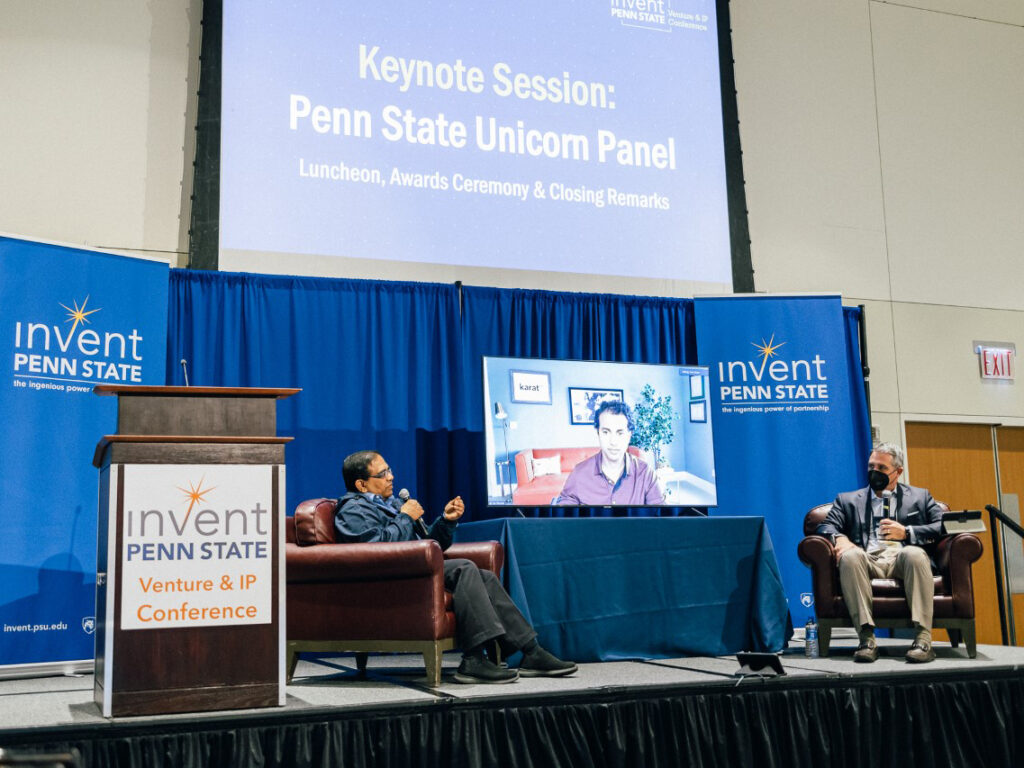
    Venture & IP Conference moderator Ryan Newman (right) talks with Penn State alumni Ash Ashutosh, Global Director of Solution Sales at Google (left) and Mo Bhende, CEO and cofounder of karat (center, via Zoom), during the Penn State Unicorn Panel on Friday. PHOTO: Invent Penn State / Rick Brandt

    On April 28-29, the 2022 Venture & IP Conference took place at the Penn Stater Hotel and Conference Center in Innovation Park. It was bookended with a first and a last: the first time that the event has been held in person since 2019 and the last conference under President Eric Barron, the visionary behind the Invent Penn State initiative. In between these milestones were more than 450 attendees representing over 60 companies from the Penn State entrepreneurial ecosystem, plus angel and venture investors looking to help innovators move their technology into the marketplace.

    The event continues to be one of the largest tech startup conferences in the Mid-Atlantic and stands apart because of its connection to Penn State-driven innovation and entrepreneurship.

    Tech Tournament propels Penn State solutions into commercialization

    After Thursday’s first round of venture connection — where entrepreneurs met with angel and venture investors to talk about funding their startups — Penn State’s Tech Tournament took place. Seven entrepreneurs with disruptive innovations boasting significant commercial potential and resulting from Penn State’s research enterprise competed for a first place prize of $75,000—funding to jumpstart their concept toward the next level. 

    “This is a place of authenticity, a place where people are grounded.”


    Moderator Erika Swift, Operations Director for Penn State College of Medicine’s Center for Medical Innovation, pointed out that over the past several years, the Tech Tournament has helped Penn State technology make significant advancements into the marketplace. 

    “In 2018, SIG Medical won second place, enabling them to refine their device and take it into clinical trials,” Swift said. She said that the company ultimately sold the technology to Zimmer Biomet, where it remains the only FDA-cleared minimally invasive rib fixation system on the market. That same year, Phospholutions, an Innovation Park-based company focused on enhancing the efficiency of global phosphorus with its product RhizoSorb,,won first place. In 2021, the company raised $10.3M in Series A funding. ConidioTec won People’s Choice that year with its nontoxic pesticide Aprehend, which has gone on to become a top choice for exterminators around the country, making a major impact on the hospitality market’s fight against bed bug infestation.

    “A total of $160,000 will be awarded,” Swift said, “to help move these innovations to the marketplace.”

    The seven startups were: 

    • NPep Therapeutics, which uses ultrasound-controlled nanomaterials to track, guide and activate on-demand the precision delivery of proteins into cells.
    • Archty Therapeutics,  an early-stage company testing an antiviral for COVID-19 based on a novel approach for defective interfering RNA
    • Epicrop Technologies, which has developed a system for the detailed investigation of epigenetic behavior in plants, which can help improve worldwide crop production by increasing a plant’s resilience to stress.
    • Bold Therapeutics, which developed a method to apply stem-cell differentiation and genome editing techniques to treat or cure Type 1 diabetes.
    • Microflap, which is a non-invasive skin flap blood perfusion measurement for use in reconstructive plastic surgery.
    • BioRES Technologies, which has developed a protein-based method for extracting and separating rare earth – a group of critical materials because of their technological importance yet lack of sustainable domestic supply.
    • Iluminate Therapeutics, which has developed precision, light-activated oncology therapy that will offer tumor reduction in head and neck tumors. 

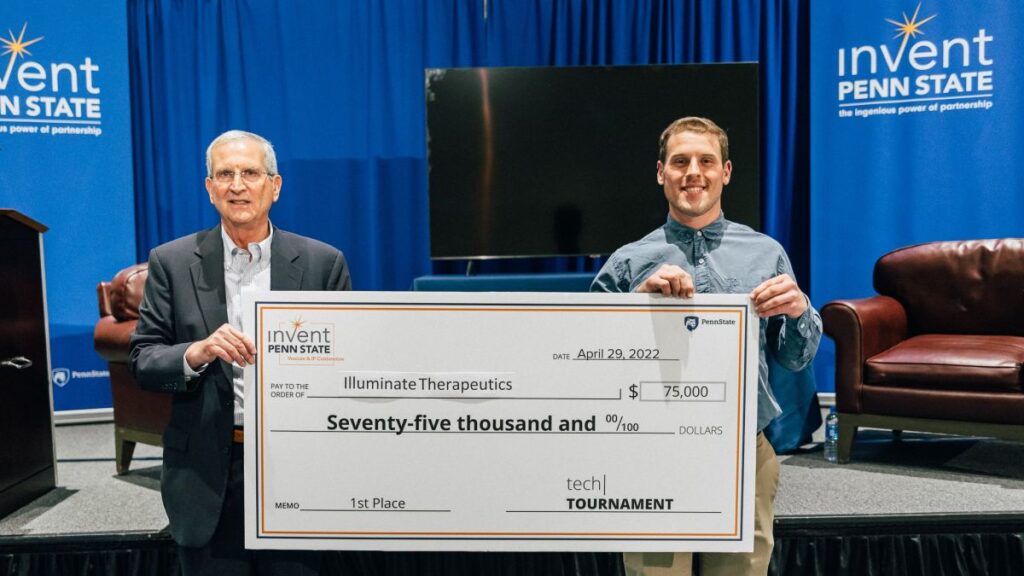
    The winner was announced on Friday: Illuminate Therapeutics won $75,000 for its disruptive technology to battle head and neck tumors. 

    “That’s where Penn State is so strong — creating stuff that is real.”

    Daniel Hayes, professor of biomedical engineering in the College of Engineering, is the principal investigator for the startup. He says that Illuminate Therapeutics’ technology takes advantage of the $1 billion head and neck cancer treatment market by using light-controlled nanodelivery to provide precise, minimally invasive tumor reduction and mitigate severe side effects relative to current treatment protocols.

    Unicorn success stories: “Penn State took a shot on me”

    Along with announcing the Tech Tournament winners, Friday was filled with Penn State success stories, from a session with Tuft & Needle co-founder JT Marino to a Unicorn panel with Ash Ashutosh, Global Director of Solution Sales at Google, and Mo Bhende, CEO and cofounder of karat.

    Both Ashutosh and Bhende, whose venture-backed startup companies have crossed the $1B valuation threshold, started their journeys at Penn State. 

    Ashutosh said, “I went to Penn State 33 years ago and this is my first time back. The bar [here at the University] has been raised on many different levels. “I probably wouldn’t be able to get in today,” he said with a laugh. He said that he came from southern India to attend Penn State and was captivated with autumn in Happy Valley … but then came winter. “Oh, trudging through that snow!” he said. 

    “All it takes is one — one investor to believe in your idea, one cofounder. Penn State took a shot on me and I feel very responsible for giving a shot back. Being a Nittany Lion was an amazing experience for me.”

    He said that attending as a student, he and his wife couldn’t afford to each buy their own cone at the Berkey Creamery, and would share one. Today things look a lot different for the couple, but Ashutosh said they’ll still split a cone. “Back then, we couldn’t afford two, and today I really shouldn’t be eating that much ice cream.”

    He spoke highly of the environment that Penn State fosters for innovation. “This is a place of authenticity, a place where people are grounded. Many times venture firms invest in virtual tools and software, but the Innovation Hub is filled with 3D printers, things that are built for real. That’s where Penn State is so strong — creating stuff that is real.” 

    Illuminate Therapeutics won $75,000 in the Penn State’s Tech Tournament for its disruptive technology to battle head and neck tumors. PHOTO: Invent Penn State / Rick Brandt

    Bhende agreed. “Penn State gave me a chance,” he said. He said that he did “all the right things in high school” but still got rejection after rejection from colleges…. Until Penn State. “Penn State was my unlock,” he said. “All it takes is one.” 

    He said that has become his mantra. “All it takes is one — one investor to believe in your idea, one cofounder. Penn State took a shot on me and I feel very responsible for giving a shot back. Being a Nittany Lion was an amazing experience for me.” 

    “There are many, many more founders here,” he said, looking out into the crowd. “They are doing the good work, representing Penn State.”

    Cara Aungst writes about industry, innovation and how Happy Valley ideas change the world. She can be reached with story ideas and comments at Cara@AffinityConnection.com.  

  • Innovation Park building renamed for pioneering Penn State alumna

    Innovation Park building renamed for pioneering Penn State alumna

    Credit Michel Lee Garrett, Penn State

    Shirley M. Malcom, Penn State alumna and senior advisor at the American Association for the Advancement of Science, was recognized on April 8th at Innovation Park where the 329 Building was renamed in her honor. Dr. Malcolm is a leader in the sciences and a pioneering advocate for minorities in the sciences, especially for women and girls of color.

    “Throughout my entire time studying, I attended predominantly white but major research institutions,” Dr. Malcom said. “I never had a Black faculty member within the science departments, so I know how difficult it is to become something you’ve never seen and to think about the fact that it’s possible. I think that’s what has spurred my entire career, whether it was as a faculty member or whether it was as a person at the association working on programs to try to bring more diverse populations into science.”

    “Honoring Penn State pioneers and innovators have long been a part of our institutional identity,” said Penn State President Eric J. Barron. “In that spirit, I’m very pleased that the ‘329 Building’ will now be known as the ‘Shirley M. Malcom Building.’ As a noted scientist, a former presidential appointee, and a leading advocate for representation in the sciences for women and girls of color, Dr. Malcom is an inspiration to those who follow in her footsteps.”

    Dr. Malcom was born in Birmingham, Alabama, where she attended schools that were segregated until she completed high school at age 16. She earned a bachelor’s degree in zoology at the University of Washington in Seattle and a masters in zoology from the University of California, Los Angeles. Dr. Malcom earned her doctoral degree in ecology from Penn State in 1974.

    In 1976, Dr. Malcom co-authored the landmark report, “The Double Bind: The Price of Being a Minority Woman in Science,” which called attention to the barriers of being an African-American woman in science. Dr. Malcom has worked to increase access to education and careers in sciences for girls and women throughout her career.

    Dr. Malcom received a Distinguished Alumni Award from Penn State and also served on the Penn State Graduate School Diversity Review Team. She has also served as the commencement speaker for the Penn State Eberly College of Science and as a featured speaker for the Penn State Forum, which exclusively highlights experts with demonstrated, multifaceted impact.

    The building renaming is part of an initiative led by President Barron. Since 2019, Penn State has renamed campus buildings to honor alumni who have helped to break down barriers. The 328 Building in Innovation Park was named in 2019 for Warren Washington, the nation’s second African American to earn a doctoral degree in meteorology. In 2021, Innovation Park’s 230 Building was named for Col. Guion “Guy” Bluford Jr., the first African American in space.

  • How Happy Valley Won a Biotech Facility Over “Cellicon” Valley

    How Happy Valley Won a Biotech Facility Over “Cellicon” Valley

    Innovation Park at Penn State will welcome BioMagnetic Solutions to 310 Innovation Boulevard as the company invests in a multi-million dollar cGMP-grade production facility. The announcement follows BioMagnetic Solutions’ January 2021 acquisition by Gamma Biosciences, a global life sciences company serving the advanced therapy market. 

    BioMagnetic Solutions is a next-generation cell selection and bioseparation technology company that develops advanced ferrofluid-based immunomagnetic cell selection systems. The late Dr. Paul Liberti and Ted Liberti founded the company in Penn State incubator space in 2011 to cultivate cutting-edge ferrofluid technology that could revolutionize the diagnosis and treatment of cancer. 

    After acquisition, Gamma Biosciences initially planned to move BioMagnetic Solutions to Philadelphia, which has been dubbed “Cellicon Valley.” But Gamma Biosciences CTO Phil Vanek says, as the team discussed the world-class resources needed to take BioMagnetic Solutions ferrofluids into the global market, a “bulb went off.”  

    “When we connected with the Innovation Park and the Center of Excellence in Industrial Biotechnology teams at Penn State, we knew we had found the right partner. Here, we have everything we need to industrialize,” he says. “We can leverage Penn State’s world-leading expertise in supply chain management, materials and analytical sciences to innovate on the ferrofluid platform. It was a compelling value prospect to put the facility in Innovation Park and became the obvious choice for us.”

    BioMagnetic Solutions CBO and co-founder Ted Liberti says he’s excited to continue to build in Happy Valley, and see the work that was started here come to fruition: “If we look forward to the next few years, we are going to see premier cell and gene therapy technologies coming from this area. We have great talent here, and we get to be a part of that. It’s good to be here building on the hard, hard work that we’ve already done.”

    “When we connected with the Innovation Park and the Center of Excellence in Industrial Biotechnology teams at Penn State, we knew we had found the right partner. Here, we have everything we need to industrialize,” he says. “We can leverage Penn State’s world-leading expertise in supply chain management, materials and analytical sciences to innovate on the ferrofluid platform. It was a compelling value prospect to put the facility in Innovation Park and became the obvious choice for us.”

    The site at Innovation Park is expected to be fully operational by mid-2022 and will feature more than 13,000 square feet of purpose-built office, laboratory and cGMP manufacturing space. The world-class facility will cement Penn State’s reputation as a destination for science and technology, specifically its emerging expertise in biotech. 

    Phil Vanek says the university’s and the region’s depth in Industry 4.0 sectors, including materials, manufacturing, supply chain and bioprocessing, will make the area a valuable resource for other advanced therapy technology companies in Gamma Biosciences’ portfolio.

    “Penn State and Innovation Park have innovative technology that’s transformative to the future of manufacturing,” Vanek says. “Then there’s the wraparound of a world-class facility, materials science and the business school. When we decided to stay put in State College, we decided to lean in a little bit. If we are going to be here, what else can we do? We’d like to make this a future marquee to reinforce bioprocessing and advanced therapies for the future of healthcare.” 

    Innovation Park Director Dan Leri says, as a former incubator company, BioMagnetic Solutions is coming full circle: “The investment from the company and Gamma Biosciences really speaks to the alignment of their business interests with Penn State’s capabilities and with the potential for workforce development and technical and operational collaboration between faculty and the BioMagnetics Solutions’ team.”

    “Penn State and Innovation Park have innovative technology that’s transformative to the future of manufacturing,” Vanek says. “Then there’s the wraparound of a world-class facility, materials science and the business school. When we decided to stay put in State College, we decided to lean in a little bit. If we are going to be here, what else can we do? We’d like to make this a future marquee to reinforce bioprocessing and advanced therapies for the future of healthcare.”

    “We are inspired to carry forward the legacy of BioMagnetic Solutions to help manufacturers overcome the challenges in scale and security of supply that are hindering true progress,” Ted Liberti added. “We have demonstrated that this technology is able to support process development and manufacturing efforts for new cell and gene-based medicines at scale, and the next step is working with developers to deliver security and reliability for their processes.”

    The state-of-the-art facility will house up to 30 technical, operational and commercial personnel to support the launch of both research use and clinical versions of the BioMagnetic Solutions Cell Separation platform. The product launch is expected in Q1 of 2022.

  • Breaking: Biotech Firm Chooses Happy Valley Location

    Breaking: Biotech Firm Chooses Happy Valley Location

    Leadership teams from Gamma Biosciences and BioMagnetic Solutions outside their location at 310 Innovation Boulevard, Innovation Park, on a visit to Penn State on November 12, 2021:
    Eric Simpson, Vice President, Gamma Biosciences
    Lindsay Wittmer, Director of Quality, BioMagnetic Solutions
    Phil Vanek, Chief Technology Officer, Gamma Biosciences
    John T. Kemshead, Chief Operating Officer & Senior Director, Clinical Scientific Affairs, BioMagnetic Solutions
    Ted Liberti, Chief Business Officer, BioMagnetic Solutions
    Matt Gunnison, President, Gamma Biosciences

    MENLO PARK, Calif. and UNIVERSITY PARK, Pa., Nov. 16, 2021 /PRNewswire/ — Gamma Biosciences, a global life sciences company serving the advanced therapy market, today announced that portfolio company BioMagnetic Solutions (BMS) has signed a lease with GLP Development to build a cGMP-grade production facility in Innovation Park at Penn State. The site is expected to be fully operational in mid-2022 with more than 13,000 square feet of purpose-built office, laboratory, and cGMP manufacturing space. ISO 13485 and ISO 9001:2015 certifications have also been achieved to ensure the highest quality standards for users of the platform.

    BioMagnetic Solutions is a next-generation cell selection and bioseparation technology company that develops advanced ferrofluid-based immunomagnetic cell selection systems. Founded in 2011 by Dr. Paul Liberti and Ted Liberti in State College, PA, the company has remained focused on developing proprietary nanoscale ferrofluids for high-performance cell selection and other bioseparation applications from research, to clinical development and commercial scale. In the new space, the team will work to support full commercialization of its proprietary selection technology platform.

    “BMS began operations in the State College, Pennsylvania area, and when we originally signed our investment deal, we knew that we would want to continue growing in the state,” said Phil Vanek, CTO at Gamma Biosciences. “When we connected with the Innovation Park and the Center of Excellence in Industrial Biotechnology teams at Penn State, we knew we had found the right location to work on developing this game-changing technology while also contributing to this thriving ecosystem to support education and innovation.”

    “Across our university’s $1 billion research enterprise, few areas have as much potential for widespread impact as biotechnology,” Geanie Umberger, Associate Vice President, Industry Research Partnerships at Penn State noted. “It is rewarding to see that BioMagnetic Solutions, a critical part of the Gamma Biosciences portfolio of companies, decided to continue their company’s evolution in State College. The alignment of their business interests with Penn State’s academic, research, workforce, and economic development capabilities, opens the door for a robust technical and operational collaboration between our faculty, staff, students, and the BioMagnetic Solutions team.”

    “We are inspired to carry forward the BioMagnetic Solutions legacy to help manufacturers overcome the challenges in scale and security of supply that are hindering true progress,” Ted Liberti, Chief Business Officer at BioMagnetic Solutions commented. “We have demonstrated that this technology is able to support process development and manufacturing efforts for new cell and gene-based medicines at scale, and the next step is working with developers to deliver security and reliability for their processes.”

    The state-of-the-art facility will house up to 30 technical, operational, and commercial personnel to support the launch of both Research Use and Clinical versions of the BioMagnetic Solutions proprietary cell separation platform. The product launch is expected in Q1 of 2022.

    About Gamma Biosciences

    Gamma Biosciences is a leading life sciences company providing products and services to support the development and manufacturing of advanced biologic therapies. Our operating companies are committed to advancing the science and art of bioprocessing by delivering market-ready innovation and expertise that helps our customers, mainly biopharmaceutical companies and contract development and manufacturing companies, safely bring therapies to patients more quickly and efficiently. Gamma is a global company with offices and major manufacturing facilities in North America, the U.K. and Belgium.

    About BioMagnetic Solutions

    BioMagnetic Solutions (BMS) develops advanced ferrofluid-based immunomagnetic cell selection systems for clinical through to commercial bioseparations applications. The BMS product platform leverages proprietary nano-magnetic ferrofluids that enable superior performance compared with existing immunomagnetic cell separation systems. Visit www.BioMagneticSolutions.com to register interest.

    About The Center of Excellence in Industrial Biotechnology

    The Center of Excellence in Industrial Biotechnology (CoEIB) stands at the epicenter of advancing a skilled workforce and stimulating research in this rapidly growing field. The CoEIB is part of the Huck Institutes of the Life Sciences (HUCK), a premier Penn State research institute which brings together faculty and students from nine colleges and 31 departments. The CoEIB leverages the Huck Institutes’ interdisciplinary expertise to achieve its goals, while preparing the next generation of leaders in industrial biotechnology.

    Integral to achieving the CoEIB’s goals are the CSL Behring Fermentation and the Sartorius Cell Culture facilities, HUCK major core facilities providing technical expertise and sophisticated equipment. In these state-of-the art environments students learn practical skills on equipment found in major manufacturing facilities, while researchers are conducting their research on the latest instrumentation.

    About GLP Development Company

    GLP is a leading real estate investment company that acquires, owns, and develops mission-critical office and flex-industrial properties that are typically leased on a long-term basis to corporations, federal agencies, state, and local governments, as well as colleges, universities, and related affiliates.

    About Innovation Park

    Innovation Park at Penn State offers a setting that serves as an engine for world-renowned research, technology, and talent. Situated on 118 acres connected to the University Park campus, Innovation Park is the center of Penn State’s entrepreneurial ecosystem and offers an onsite network of resources for startups and growing businesses.

    SOURCE Gamma Biosciences